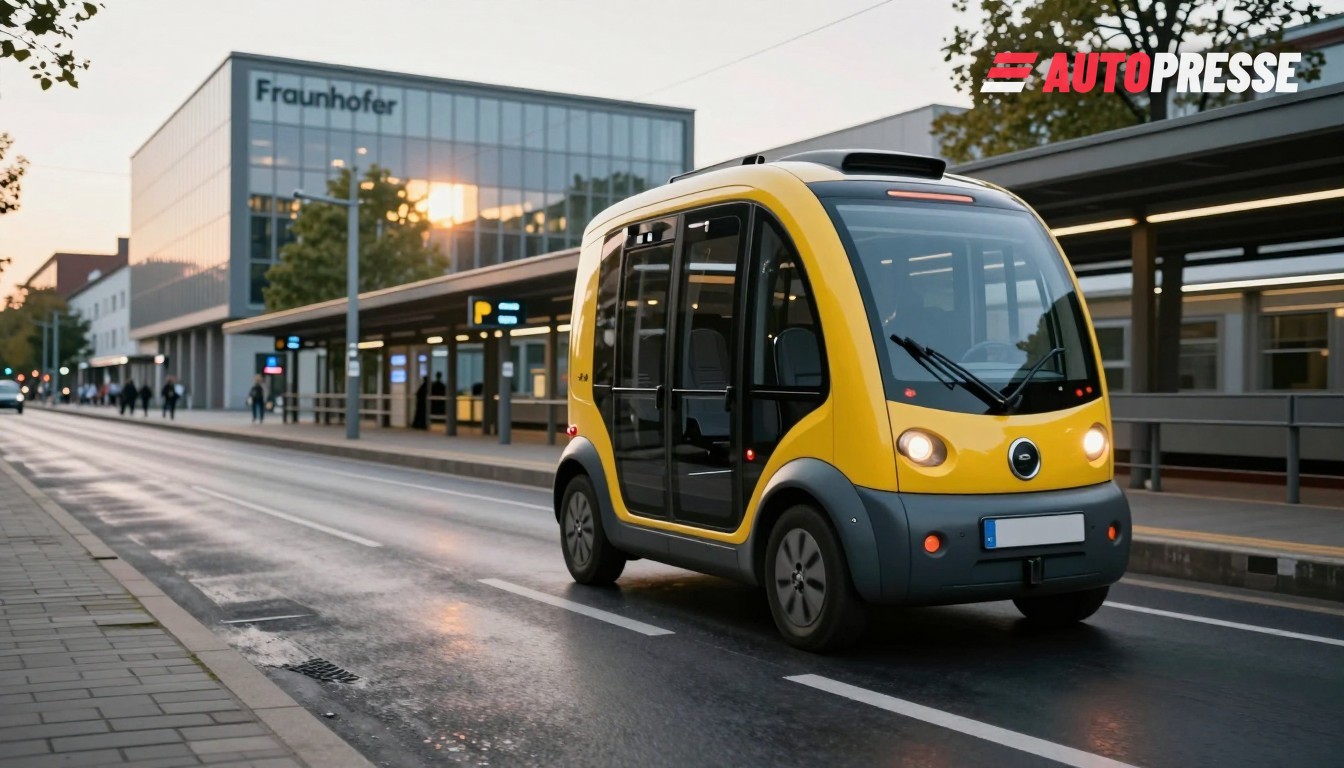
Fraunhofer IAO has received an Erprobungsgenehmigung to operate its automated shuttle «BumbleB» on Nobelstraße in Stuttgart, allowing tests on public road sections between the local S‑Bahn station and the Fraunhofer research campus. The permit, issued on 9 November 2026, moves BumbleB from closed‑campus trials into real public‑space trials — a significant moment for commuters, employers seeking climate‑friendly staff mobility and local transport planners watching last‑mile options.
From lab to Nobelstraße: what changed
The Fraunhofer release says BumbleB previously ran regular shuttle trips across the institute’s private grounds since April 2026 and that the new testing permission from the Kraftfahrt‑Bundesamt/KBA enables the next phase: supervised operation on the public road linking the S‑Bahn and research campus. Project partners named include the Hochschule Esslingen for vehicle development and Bertrandt AG for the vehicle platform; the software stack is built on an open‑source automated driving stack combined with regional engineering expertise. The institute frames the step as part of the IZSMO mobility project, funded under Germany’s national mobility programmes.
Technical and operational notes
According to Fraunhofer, BumbleB integrates a physical‑AI approach: the vehicle combines sensors, perception software and a control stack validated on campus before public trials. The permit relies on coordination between technical partners, local authorities and federal regulators to ensure safe, incremental testing on a short, defined route. Fraunhofer highlights that testing will also collect user feedback, CO2‑savings data and operational learnings for scaling similar solutions elsewhere in Germany.
What this means for the market
For cities, mobility managers and employers, the BumbleB permission is proof that regulatory and technical barriers can be bridged quickly when research institutes, suppliers and local agencies collaborate. For drivers and employees, first‑mile/last‑mile shuttles offer new options to replace short commuter car trips or reduce demand for on‑site parking. For suppliers and software teams in Germany and the wider D‑A‑CH market, the project underlines growing demand for validated, safety‑conscious AI stacks and integration services rather than speculative prototypes. The move also creates opportunities for local workshops and fleets to learn new maintenance and telemetry workflows linked to automated vehicles.
Operational pilots like BumbleB provide a testbed for business models (employer‑funded shuttles, micro‑transit links, mobility hubs) and technical standards (sensor suites, remote supervision, open‑stack validation) that will shape how AI is adopted across Germany’s transport networks. Observers should watch the data Fraunhofer publishes about reliability, user acceptance and measured emission benefits — these will be the hard numbers that turn pilots into repeatable deployments.
Solutions like those developed by DaVinci AI — autonomous multi‑agent systems, voice agents that handle bookings and qualification calls, and persistent‑memory assistants that coordinate schedules and maintenance — map directly to the needs of pilots such as BumbleB. Dealers, fleet operators and mobility managers can use these AI tools to automate bookings, optimise vehicle allocations, produce compliant marketing materials and keep passengers informed in real time, helping pilots scale from research demos to reliable daily services.
WorldTrader24 B2B-Fahrzeugmarkt für Händler →
Sources: Fraunhofer IAO, Informationsdienst Wissenschaft (idw)