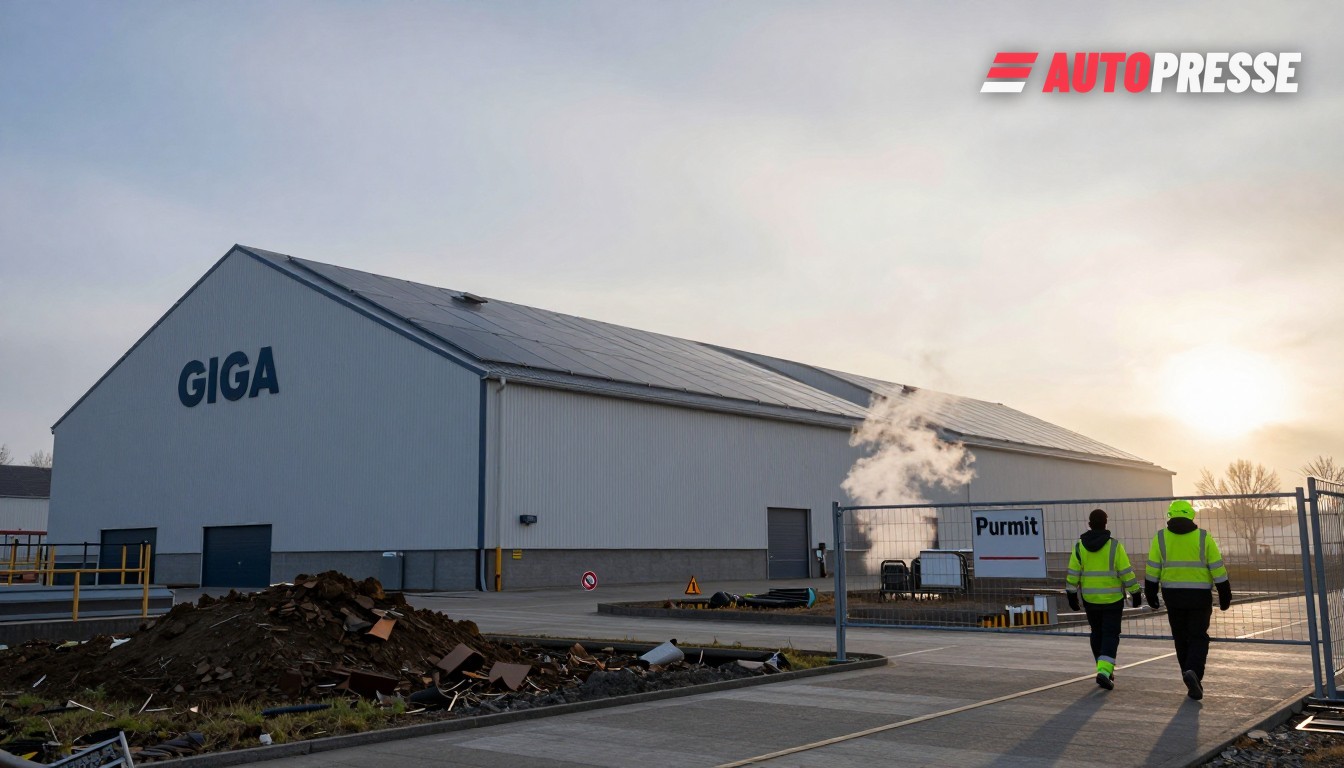
Tesla’s Gigafactory in Grünheide is moving from ramp to expansion — and the implications are felt across Germany and neighbouring Austria. The company told regional media it will file the permit package for a second production hall in December 2026, a building that would be more than twice the size of today’s main hall and part of a long‑term plan that could lift Grünheide toward a 1‑million‑cars‑a‑year footprint over the coming decade.
What Tesla is announcing — and what is already in place
The near‑term steps are concrete. Tesla confirmed the December permit timeline to Brandenburg authorities and rbb; independent reporting notes the proposed northern hall would cover roughly 536,000 m² and that construction could begin in 2027 if approvals follow.
Operational details matter for local industry: Tesla says Giga Berlin has recycled 100% of its process wastewater for two years, returning about 465 million litres into production during that period — a claim the company has publicised as it seeks to limit new water demand for any expansion.
Alongside factory space, Tesla is accelerating capabilities. The company is hiring broadly around Grünheide and in Berlin engineering centres for manufacturing, process and validation work; separate reporting and company event pages show active recruitment and a new engineering hub that will support the plant and European validation. Elective and Battery‑news reporting say Tesla plans to grow local cell production at Grünheide — a pilot/4680‑cell effort scaled toward roughly 18 GWh in near‑term plans — positioning the site as both car and cell producer.
How Germany and Austria sit in the new landscape
Europe’s EV supply chain is already capital‑heavy: research group New Automotive estimates almost €200bn of commitments across the European Economic Area and Switzerland to date, with Germany accounting for roughly a quarter of announced investment. That concentration makes a German cell and vehicle hub such as Grünheide strategically important for suppliers in Germany and Austria looking for volume and high‑value battery work.
For Austrian suppliers and engineering firms (many of which already work inside German value chains), Grünheide’s extension creates demand for tooling, battery components, thermal systems and validation services — work that often flows cross‑border. Tesla’s public hiring and the Berlin engineering centre also draw specialised engineers and validation capacity that European OEMs and tier‑1s in Austria must compete for.
What this means for the market
1) A push for localisation: a larger Grünheide that includes cells raises the stakes for European battery suppliers and for Austrian engineering houses to win contracts. Germany’s existing industrial base gives it an advantage; Austria’s specialist firms can gain new work if they move fast.
2) Infrastructure and approvals remain binding constraints: Tesla’s December permit filing and the multi‑year buildout show how capacity gains depend on local permitting, grid and water management rather than pure capital alone. Tesla’s wastewater recycling claim aims to blunt one of those constraints.
3) Skills competition and supplier mix: hiring around Grünheide and new engineering hubs will compete with German OEMs and Austrian suppliers for engineers, technicians and validation specialists — a near‑term labour pressure that will shape where suppliers locate equipment and R&D.
4) Scale matters for price and bargaining power: larger local cell capacity reduces logistics and currency exposure for manufacturers; it strengthens negotiating leverage for nearby suppliers and may accelerate consolidation among specialist vendors in Austria and southern Germany.
B2B vehicle marketplace on WorldTrader24 →
Sources: Tesla (company announcements and event pages), rbb24, EVXL, electrive, Reuters / New Automotive.