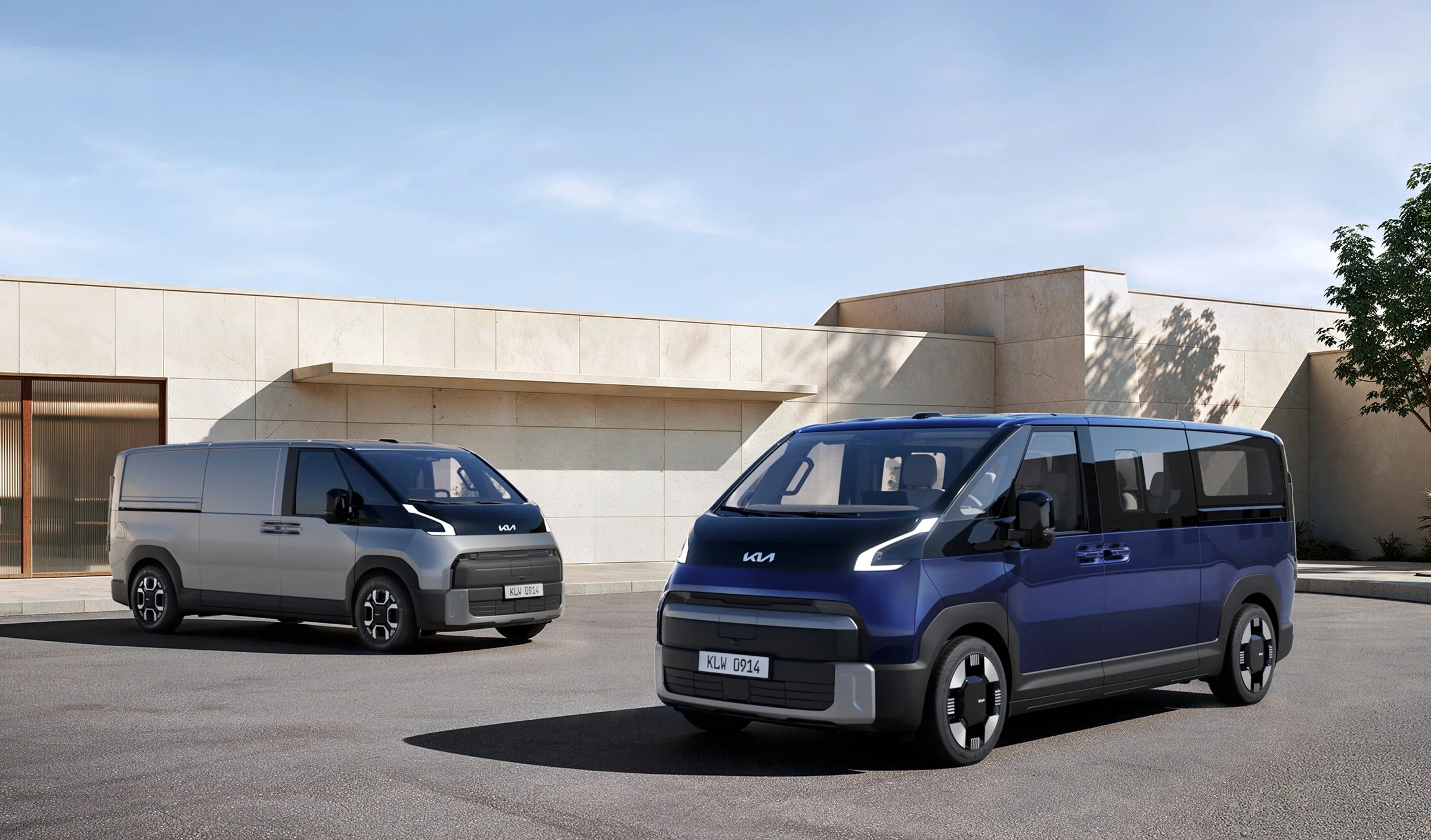
Germany and Austria’s fleet buyers, commercial dealers and van converters should watch the PV7. Photographers caught a heavily disguised Kia PV7 prototype performing a tow test on European roads — proof the large PBV (purpose‑built vehicle) is in late validation — and Kia unveiled the production intent at IAA Transportation in Hanover on 14 September 2026. These are concrete signs that Kia is scaling its PBV strategy from the compact PV5 up into a true large‑van segment that matters for trades, shuttles and logistics operators across DE and AT.
What the spy shots actually show
Published spy photos captured the PV7 while towing a trailer during hot‑weather testing; the images show a tall, square body with sliding doors, a vertical liftgate and a large windshield — a clear focus on load volume and usability rather than sporty styling. Kia positions the PV7 as the next step after the PV5 and says the PBV line will expand; development images and on‑road tests underline the vehicle’s work‑oriented packaging.
Independent reporting and Kia’s own communications describe the PV7 as riding on a commercial‑focused electric architecture related to the PV5 (an E‑GMP‑derived ‘‘Electric‑Global Modular Platform for Service’’) and intended to support multiple battery and body configurations. Test‑mule behaviour — towing and chassis validation — confirms Kia aims to prove payload and duty‑cycle durability for European commercial customers.
Confirmed specs and timing (what we can verify)
Published sources that compiled Kia’s announcements and industry reporting list provisional technical targets: two battery options reported (around 71.5 kWh and 96.2 kWh), an 800‑volt electrical architecture for fast charging, a provisional WLTP‑style range north of 460 km, a quoted cargo volume target near 8.0 m³ and a headline payload around 1,200 kg. Journalists and industry briefings put the PV7’s commercial launch window in the second half of 2027 after its IAA debut. These figures are reported as manufacturer targets and trade reporting; final homologated WLTP numbers, variant‑by‑variant payloads and German/Austrian pricing remain to be published.
What this means for the market
Kia’s PV7 moves a high‑profile Asian PBV into direct competition with the Volkswagen Group’s light commercial range and specialist converters that serve German and Austrian fleets. An 800‑volt architecture and >460 km provisional range, if confirmed in series form, shortens downtime for long‑distance logistics and intercity shuttle operators — a decisive factor for fleet total cost of ownership in Germany and Austria where charging infrastructure and curbside operations are increasingly optimised. Dealers should prepare for new conversion and service needs (e.g., high‑voltage battery repairs, trailer‑ready powertrain calibration), and fleet managers will want verified towing and payload tests before committing at scale.
For workshops and converters in DE/AT the PV7’s late‑stage testing and IAA reveal mean lead times for body conversions and specialised equipment are shortening: Kia’s PBV programme is explicitly built to accept multiple upper‑body layouts, which should simplify homologation for ambulance, refrigerated, passenger‑shuttle and tradesman fitouts — but licensors and converters will need concrete technical packs from Kia to plan installations.
Large transporters for dealers on WorldTrader24 →
Sources: Kia Corporation (worldwide newsroom), autoevolution, ev.news, Car‑Newsdesk / cenews