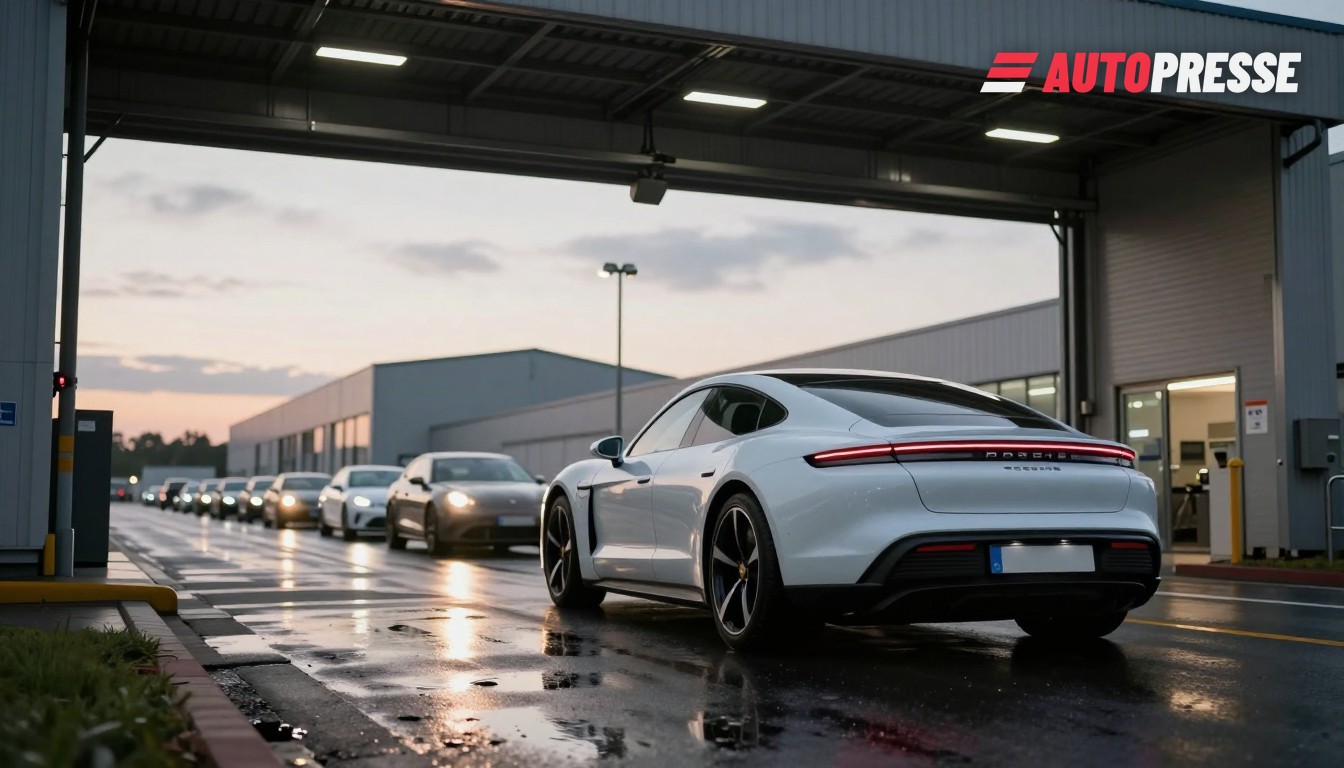
Porsche this week moved AI from lab demo to customer cars: the Stuttgart maker has introduced a new generation of Porsche Communication Management (PCM) for the 911, Taycan, Panamera and Cayenne that pairs a hardware uplift with an "AI‑powered Voice Pilot" (based on a large language model), a 3D navigation display and integrated Apple Music with Spatial Audio. Porsche published the technical brief on 3 November 2026; international coverage followed (e.g. T3 on 5 November 2026).
What Porsche announced
Porsche says the new PCM hardware delivers up to five times the computing power of the previous generation, enabling faster start‑up, smoother multitasking and an architecture that can be evolved via over‑the‑air updates. The company explicitly describes the Voice Pilot as "powered by AI and based on a large language model", able to process natural language, multi‑step requests and follow‑up questions; navigation, media, selected vehicle functions and apps can be controlled by voice. Porsche named Oliver Seifert, Head of Infotainment & Connect, to explain the strategy: “This new generation of infotainment means we can create a more powerful digital platform that combines enhanced performance, intelligent connectivity and a consistent user experience across multiple model lines.” Availability will be phased in on newly produced cars in the four model lines; market and equipment availability will vary by market and production date.
What this means for the market
This is a concrete, production‑facing AI deployment from a German premium maker — not an experiment. For drivers it means improved voice control and route planning that explicitly includes EV charging stops and battery preconditioning for electric models; for dealers and service operations it raises new demands for in‑car software knowledge, OTA management and data‑ops. Porsche’s move also underlines the sector trend away from one‑off features toward pluggable, updatable software platforms that require integration across UX, connectivity, infotainment suppliers and aftersales teams.
Technically, Porsche’s package shows three industry lessons: (1) AI functions increasingly live on a higher‑power in‑car compute stack rather than being purely cloud‑hosted; (2) automakers are coupling voice/LLM capabilities with navigation and vehicle state (for example EV charging planner and battery preconditioning); and (3) over‑the‑air update channels have become the release vehicle for successive AI improvements. These are factual claims grounded in Porsche’s 3 November 2026 announcement and the subsequent press reporting.
For owners and workshop teams the near‑term impact will be practical: technicians need access to new diagnostic and software‑update processes, retailers must explain subscription requirements (for Apple Music or optional services) and OEM aftersales must guarantee privacy, security and clear fault‑handling paths when an LLM‑powered assistant interacts with vehicle controls. Porsche’s release explicitly warns that some services (e.g. Apple Music with Spatial Audio) are available in "selected Connect markets" and may need subscriptions or specific sound systems.
In short: Porsche’s announcement on 3 November 2026, corroborated by coverage on 5 November 2026, is a clear signal that AI is moving from isolated proofs into the mainstream feature set of German premium cars.
Across the retail and service chain, solutions that automate phone handling, qualify leads, produce compliant marketing assets and scan market pricing data will be vital to keep pace with faster software feature cycles and customer questions. Platforms that provide autonomous agents, voice agents and dealer‑stock analytics can let retailers implement and explain AI features while reducing the operational burden.
Porsche Taycan listings on WorldTrader24 →
Sources: Porsche Newsroom, T3