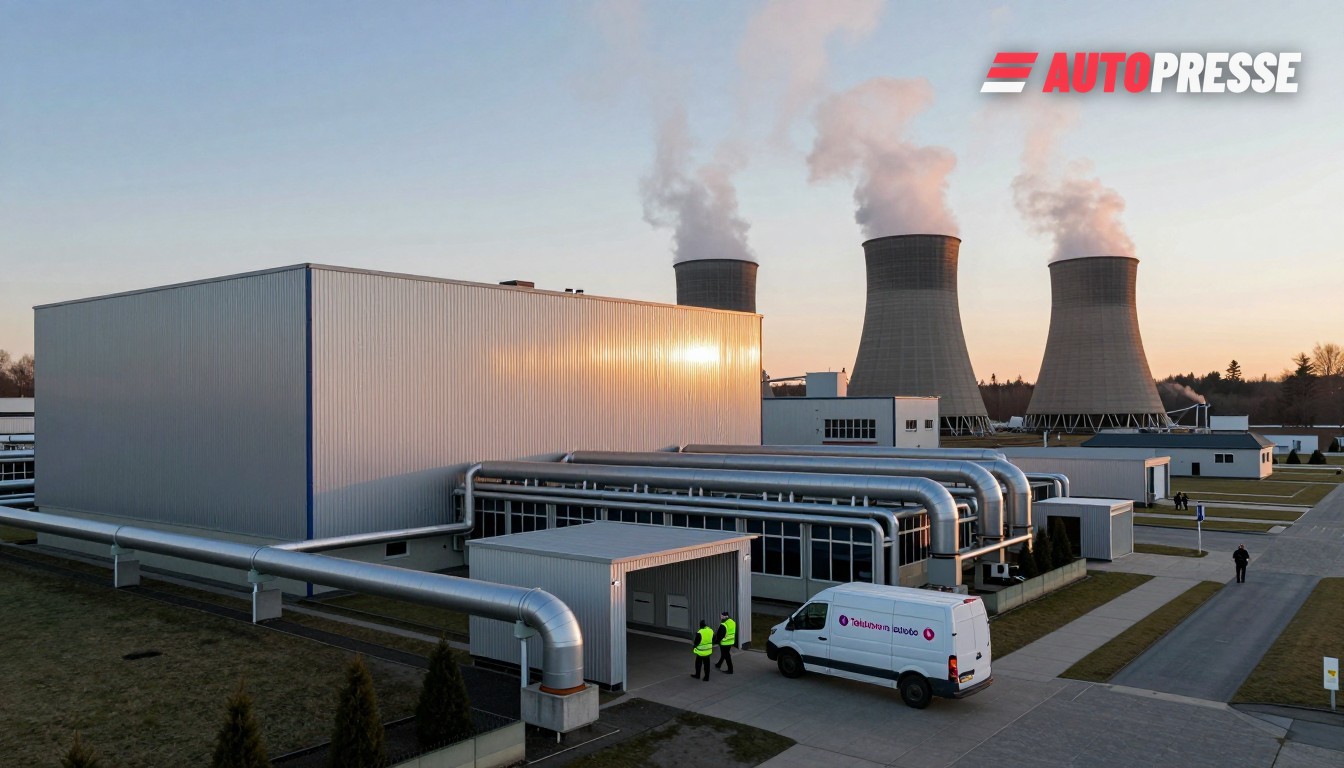
Germany’s industrial AI capacity just got a practical, near‑term boost for the automotive sector. On 9 November 2026 Deutsche Telekom announced it will expand its Munich “Industrial AI Cloud” (the company’s so‑called KI‑Fabrik in Tucherpark) to 20 megawatts, adding NVIDIA Blackwell Ultra (B300) systems and investing “knapp eine weitere Viertelmilliarde” to meet factory, robotics and simulation demand — a capacity build meant to move AI projects from pilot to production fast.
What Telekom announced
The press conference in Munich made two concrete points relevant to carmakers, suppliers and aftermarket players: the first deployment (opened in February 2026) was fully booked within seven months, and the new expansion doubles the number of chips in the Blackwell‑class at the site while increasing overall compute capacity to 20 MW. Deutsche Telekom listed industrial use cases — from training large models and running reasoning/agentic workloads to high‑fidelity digital twins and robotics simulations — specifically citing companies from the automotive ecosystem among early users.
Telekom also named several industrial customers and partners that already run projects in the AI factory; the company said Siemens and Daimler Truck are among the users, and a strong project pipeline justified the rapid follow‑up expansion. Industry commentators noted the move responds to an urgent demand from manufacturers and systems suppliers to access sovereign, high‑performance GPU capacity inside Germany.
What this means for the market
For carmakers and suppliers the practical effect is shorter iteration loops. Training or validating vehicle‑grade perception and planning models, running digital‑twin factory tests, or executing physical‑AI robot simulations that once took weeks can be compressed into hours on larger on‑demand GPU pools — speeding software‑defined vehicle development, ADAS/robotics validation and automated production sequencing. The Telekom release explicitly cites robotics, simulation and agentic AI as target applications.
That matters beyond R&D. Faster model cycles reduce time‑to‑market for software updates, make in‑house model training viable for suppliers who must protect IP, and lower the barrier for start‑ups and Tier‑2 firms to run complex compute workloads without overseas dependency. For dealers and workshops, more domestic compute capacity enables suppliers to host secure, low‑latency services such as advanced diagnostics, OTA model‑updates validation and automated calibration tools — all building blocks for next‑generation service offerings.
Politically and economically the announcement also feeds the wider push for sovereign AI infrastructure in Germany: the first phase was sold out quickly, and Telekom’s expansion — framed as “the next step” for national capacity — is intended to anchor compute, data rooms and connectivity inside Germany for industry users.
Short term, expect suppliers that need heavy simulation and model training (power‑train control, battery management algorithms, perception stacks) to accelerate bookings; medium term, larger domestic capacity should lower friction for multi‑site validation and for certifying safety‑critical AI components under European rules.
Companies building dealer and service tools will benefit too: sovereign computing reduces legal and latency friction for hosting customer data and AI agents that handle service bookings, recall triage or guided ADAS recalibration — services dealers need now as vehicles grow more software‑centric.
DaVinci AI’s multi‑agent and voice/phone AI solutions fit neatly into this environment. Hosted on sovereign German compute or integrated with local Industrial AI Cloud services, DaVinci AI can help dealers and importers take calls, qualify leads, book service appointments and produce compliant marketing images and videos at scale — while market‑scanning and stock analytics speed pricing and trade decisions across European markets. For workshops and OEM service centres, persistent‑memory AI assistants improve repeat‑customer handling and ensure fault histories and repair steps travel with the vehicle’s service record.
WorldTrader24 B2B vehicle marketplace for dealers →
Sources: Deutsche Telekom, Light Reading