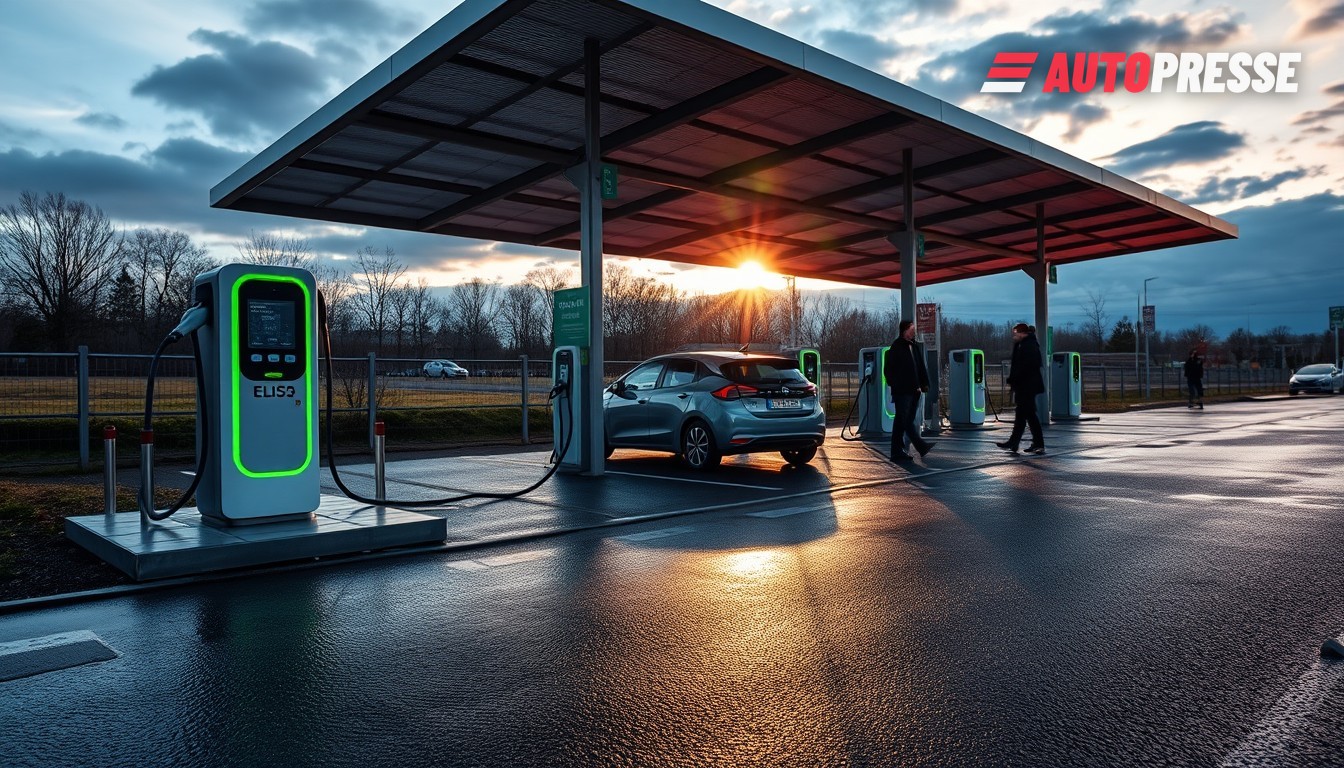
Stuttgart — The German fast‑charging network just grew again: eliso announced five new rapid‑charging sites that came online in late October, adding 24 high‑power charging points (200–400 kW) to its national network and offering an opening ad‑hoc price of €0.49 per kWh at its new locations. This matters to drivers, dealers and charging‑station workers across Germany — and to Austrians who cross into Bavaria — because it shows how public charging access and prices are being set in the practical rollout of the federal Deutschlandnetz program.
What was opened and when
AutomatenWegweiser reported on 26 October 2026 that eliso brought five new sites into service (locations in Niedersachsen, Brandenburg, Bayern and Baden‑Württemberg) with a total of 24 ultra‑fast charge points capable of 200–400 kW charging. The article says two of those sites belong to the federally funded Deutschlandnetz.
Eliso itself confirms the launch details on its public communications channels and highlights the customer‑facing options: contactless card payments, RFID/ladecard and QR‑code ad‑hoc payments, and an introductory ad‑hoc price of €0.49 per kWh at new sites.
Pricing and the wider picture
The eliso opening price of €0.49/kWh sits amid a wide spread of ad‑hoc public DC prices in Germany. Independent tests and market reports this autumn underline that drivers must still shop around: a recent high‑power charging test and market review highlighted that ad‑hoc prices can be much higher at some networks (the report noted ad‑hoc charges at EnBW public chargers of about €0.79/kWh in its test sample), while smaller or regional operators sometimes offer lower public ad‑hoc rates — for example the community‑run Ladepark A44 lists €0.39/kWh for direct payment. The result is substantial price variation for the same kilowatt‑hour depending on operator, location and payment method.