Germany and Austria’s supplier landscape has shifted from firefighting to strategic repositioning. Two corporate decisions this autumn — Infineon’s landmark investment in Villach and Bosch’s legal reorganisation of its Mobility unit — are reframing where high‑value work, funding and negotiating power sit for the region’s carmakers and Tier‑1s. Drivers, dealers and parts shops will feel the effects through longer‑term supplier location decisions and contract reassignments; employees and works councils face concrete dates and new legal steps to manage.
Infineon builds a 300mm GaN competence centre in Villach
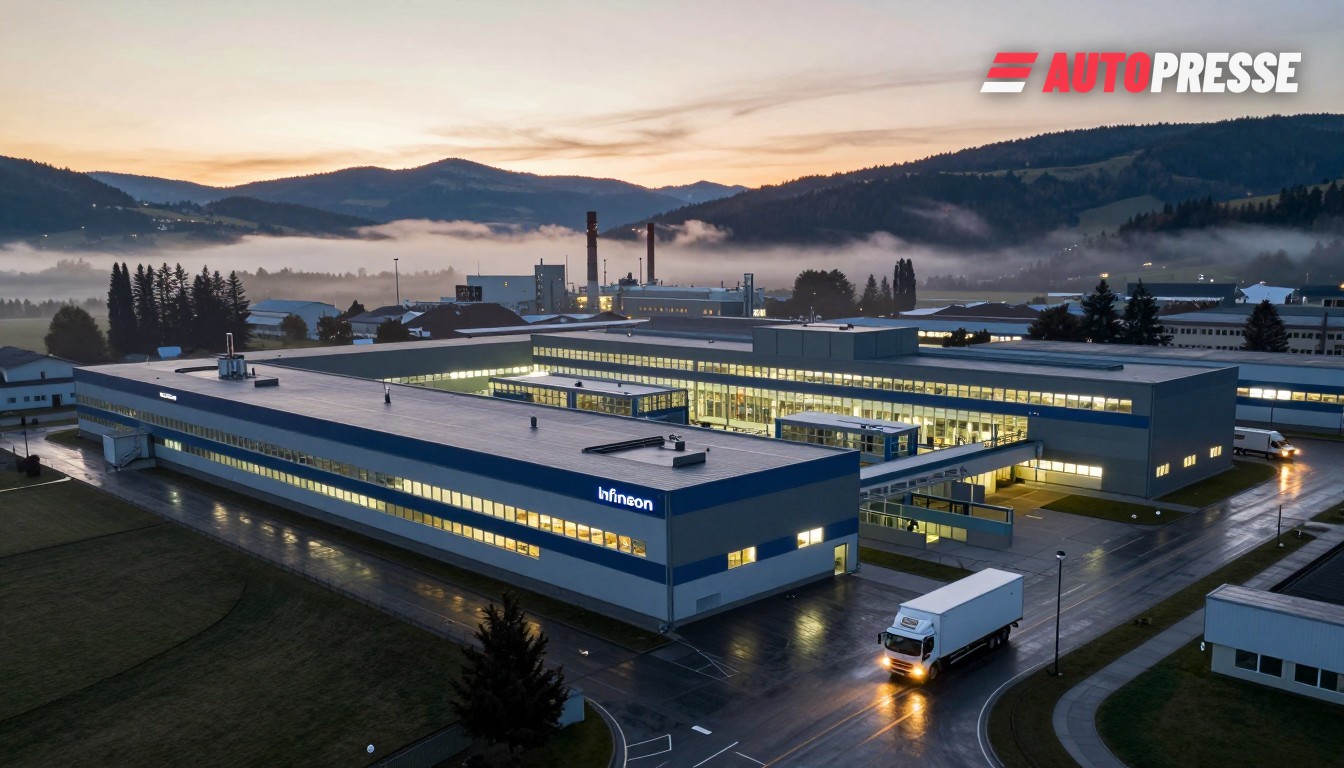
On 27 October 2026 Infineon announced a plan to invest around €1.1 billion at its Villach site to create Europe’s first high‑volume manufacturing line for gallium‑nitride (GaN) power semiconductors on 300‑millimetre wafers, with production scheduled to begin by the end of 2027. The project received €319 million of support under the European Chips Act; Infineon says Villach currently employs about 4,800 people on site and that the investment will strengthen the local semiconductor ecosystem. Jochen Hanebeck, Infineon CEO, called the move “the first company in the world to bring gallium nitride power electronics into volume production.”
The implications for automotive suppliers are immediate: GaN chips boost efficiency for onboard inverters, on‑board chargers and power electronics widely used in BEVs and fast chargers, creating upstream demand for precision packaging, testing and thermal management — activities likely to remain concentrated in Austria and southern Germany because of Infineon’s Villach commitment. The announced timeline to ramp volume production (end‑2027) gives component and contract manufacturers a narrow window to qualify for series supply.
Bosch splits Mobility into separate GmbHs — contracts and labour change
Robert Bosch announced a structural reorganisation in October 2026 that will move the Mobility business and three central service units in Germany into four wholly‑owned GmbHs, effective 1 August 2027. Approximately 62,500 employees will transfer to the new group companies while roughly 3,000 staff remain at the Robert Bosch GmbH central research and corporate functions. Bosch says the move is intended to speed decision‑making and free the Mobility unit for partnerships; company filings also show the Mobility business generated about €55.8 billion in 2025 (≈60% of group revenues). Works councils and suppliers have been urged to review framework agreements because contractual counterparties may change with the legal handover.
For suppliers to carmakers and to Bosch itself, the legal separation matters: long‑standing master agreements with “Robert Bosch GmbH” may need novation or reassignment when supply responsibilities move to a Bosch Mobility GmbH. Procurement teams and mid‑tier subcontractors should audit contract wording and lead times now to avoid disruption when the transfers occur.
Other moves: financing and regional footprints
Outside pure automotive semiconductor and equipment news, Austria’s FACC — a Tier‑1 aerospace supplier with multi‑site production in Upper Austria — has locked in a new EUR 190 million syndicated loan led by UniCredit Bank Austria to underpin a planned EUR 350 million investment programme to 2030 (capacity expansions, automation and R&D). That refinancing shows banks remain willing to fund manufacturing scale‑ups in Austria even as automotive suppliers recalibrate. Meanwhile ZF’s corporate disclosures underline the group’s substantial footprint in Austria (ZF Holding Austria GmbH, Steyr) and its cross‑border JV and equity positions, a reminder that supplier networks here are already transnational and capital‑intensive.
What this means for the market
Short term: suppliers should expect contract reviews, re‑negotiations and a narrow window (through 2027) to qualify for new GaN‑enabled power‑electronics value chains. Medium term: Infineon’s Villach investment anchors high‑value chip processing in Austria, increasing local demand for testing, packaging and thermal‑management suppliers. Bosch’s legal separation increases contractual complexity and could accelerate outsourcing or reshoring choices as the new GmbHs seek agility and partners. For employees, the August 1, 2027 transfer date is the legal hinge point for employment‑law protections and works‑council negotiations. For dealers and aftermarket businesses, the likely concentration of semiconductor and power‑electronics supply in regional clusters means parts lead times may shorten for some components and lengthen for others — plan procurement and qualification now.
WorldTrader24 B2B-Fahrzeugmarkt für Händler: Angebote durchsuchen →
Sources: Infineon Technologies, Robert Bosch GmbH / Dr. Web, FACC, SKF, ZF