City deliveries in Germany and Austria are shifting from diesel to battery power faster than many expected — and that is reshaping terminals, charging demand and operating costs for hauliers and retailers. For drivers, dealers and logistics workers the change means new vehicles, new depot chargers and new price pressures on routes that leave the city.
Electrifying the last mile — two big steps
Deutsche Post DHL Group reported that, as of 17 September 2026, it operates 40,000 electric delivery vehicles in Germany, a milestone the company says reinforces its position as a leader in e‑mobility for parcel and postal services.
The group has set an ambition to electrify 66% of its last‑mile fleet by 2030 and already purchased large batches of electric vans in 2025 as part of that plan.
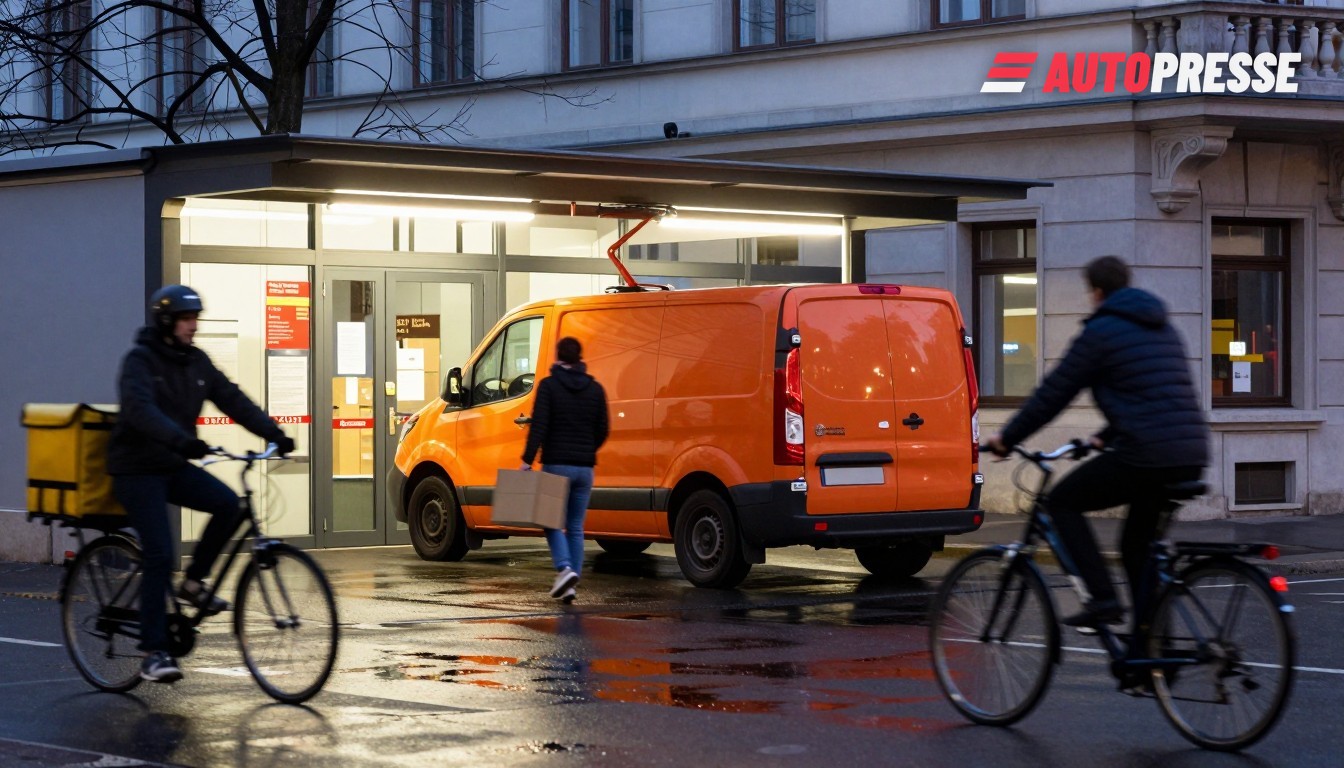
In Austria the shift is already visible on the streets: on 15 June 2026 Austrian Post announced Vienna’s delivery operation had been switched entirely to electric vehicles, supported by a reported €32 million investment in vehicles and charging infrastructure; the operator said roughly 1,000 e‑vehicles now cover about eight million kilometres a year in the capital.
Warehouses, automation and where the chargers go
Retailers and logistics landlords are matching the vehicle roll‑out with large automation and depot projects. REWE started construction of the ALPHA logistics centre at Wiener Neudorf on 13 May 2026 — a €600 million, ~150,000 m² development with a fully automated high‑bay warehouse and about 87,000 pallet spaces — designed to consolidate stock and bring charging and robotics under one roof.
That combination — electric fleets plus large automated hubs — concentrates overnight charging loads at a smaller number of sites. Operators and municipalities now face a practical scheduling challenge: where to place high‑power chargers close to dense urban depots without overloading local grids.
What this means for the market
Two market forces are colliding. On the one hand, electrification lowers urban emissions and, at scale, operating costs for short runs; Austrian Post estimates Vienna’s switch saves about 2,300 tonnes of CO₂ a year and supports local jobs in last‑mile delivery.
On the other hand, EU and national toll reforms are increasing long‑haul costs, shifting the cost calculus for operators who run both urban and intercity routes. The Council of the EU adopted a negotiating mandate on 4 March 2026 to clarify CO₂‑based HDV charging rules under the Eurovignette, formalising the roll‑out of CO₂ components in tolls from mid‑2026.
Independent trackers show tolls rising across Europe: the IRU/industry index was up strongly through 2026 and Austria’s tolls rose by about 7.7% partly because of the CO₂ component, while Germany’s CO₂ surcharge now accounts for a large share of truck tolls. That makes cross‑border route planning and vehicle classification materially more important for margins.
For fleets this means three immediate actions: accelerate depot charging roll‑outs where urban volumes justify the capex; redesign route portfolios so e‑vehicles concentrate on predictable short runs; and re‑price long‑haul contracts to reflect higher per‑kilometre toll and CO₂ charges. Companies that combine automated warehousing with on‑site charging will gain a cost and operational edge.
Sources: DHL Group, Austrian Post, REWE, Council of the EU, TrasportoEuropa / IRU, HGV Ireland