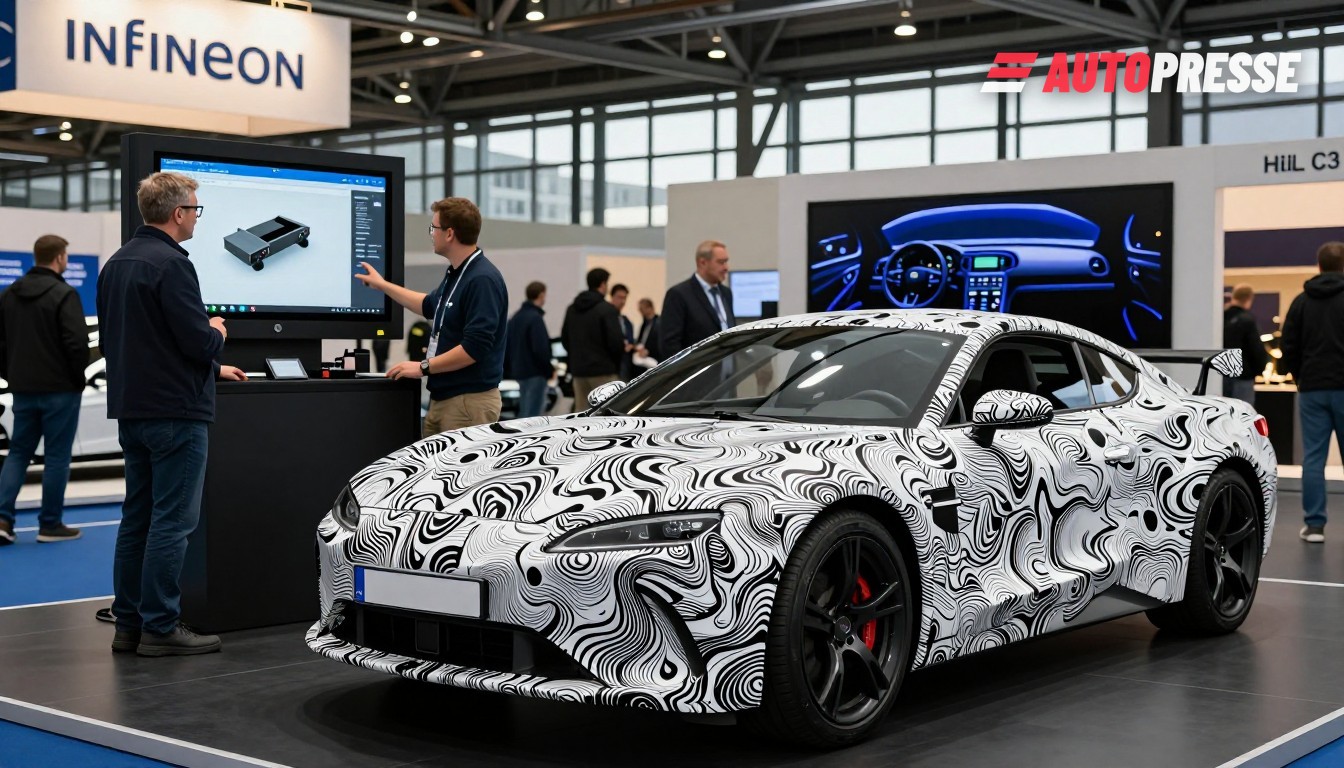
Munich — A new wave of AI is moving from toolchains into the heart of automotive electronics. Infineon introduced the AURIX RC1 microcontroller family on 4 November 2026 and is presenting the concept at electronica in Munich (10–13 November 2026). The chipmaker positions AURIX RC1 as a RISC‑V‑based platform for software‑defined vehicles (SDV), edge AI and so‑called Physical AI applications.
What was announced this week
On 10 November 2026 TASKING published a press release saying its unified VX‑toolset, winIDEA and BlueBox debug environment and verification stack will support Infineon’s AURIX RC1 and that the toolchain embeds agentic AI to accelerate development and certification workflows. TASKING says engineers will be able to compile, debug and verify AURIX RC1 systems from a single, AI‑assisted toolchain.
TASKING told attendees that new AI skills for the VX‑toolset will arrive in December 2026 and that the winIDEA AI Kit has “already shown at least 50% effort reduction in three use cases.” The company emphasised the principle “AI assists, engineers decide.” TASKING also invited visitors to see a live demo at Infineon’s electronica booth (Hall C3, Booth 502).
Why the pairing matters
Infineon says AURIX RC1 is designed to scale from traditional microcontroller roles to hybrid MCU/MPU devices with up to 12 32‑bit cores, an edge‑AI parallel processing unit and up to 40 MB of embedded memory — features intended to support zonal architectures, chassis and battery management, cockpit and safety functions in future SDVs. Infineon also states it plans to offer samples in the first half of 2027.
Bringing AI into the developer toolchain shortens the V‑cycle for complex multicore systems: virtual prototypes and AI‑assisted migration tools let teams start software work before silicon arrives and automate repetitive verification tasks, lowering cost and calendar risk for OEMs and Tier‑1 suppliers. TASKING frames this as a migration path for teams moving from TriCore or Arm to RISC‑V without rebuilding entire toolchains.
What this means for the market
For German and Austrian suppliers, the announcement tightens the link between semiconductor roadmaps and vehicle software schedules. Faster, AI‑assisted toolchains reduce time‑to‑market for SDV features and make certification evidence easier to produce — an immediate advantage where safety standards and functional‑safety certification remain gatekeepers for new features. For carmakers and Tier‑1s, the combination of Infineon silicon and an integrated, AI‑enabled toolchain promises fewer integration risks when consolidating functions into zonal computers and central domain controllers.
Short term this is a tools and ecosystem story (samples H1 2027; TASKING tools from December 2026), but the medium‑term effect is architectural: if manufacturers adopt AURIX RC1 at scale, software developers across Germany and Austria will increasingly rely on AI‑assisted workflows to meet tight delivery and certification timetables.
Solutions like those from DaVinci AI — autonomous multi‑agent systems, AI phone and voice agents, market‑scanning and dealer‑stock analytics, plus AI image/video production and assistants with persistent memory — directly complement this trend by helping dealers, workshops and manufacturers handle more complex software‑led products, automate customer touchpoints and turn technical capabilities into sales and service outcomes.
WorldTrader24 B2B vehicle marketplace for dealers and OEMs →
Sources: TASKING (Business Wire / StreetInsider), Infineon Technologies