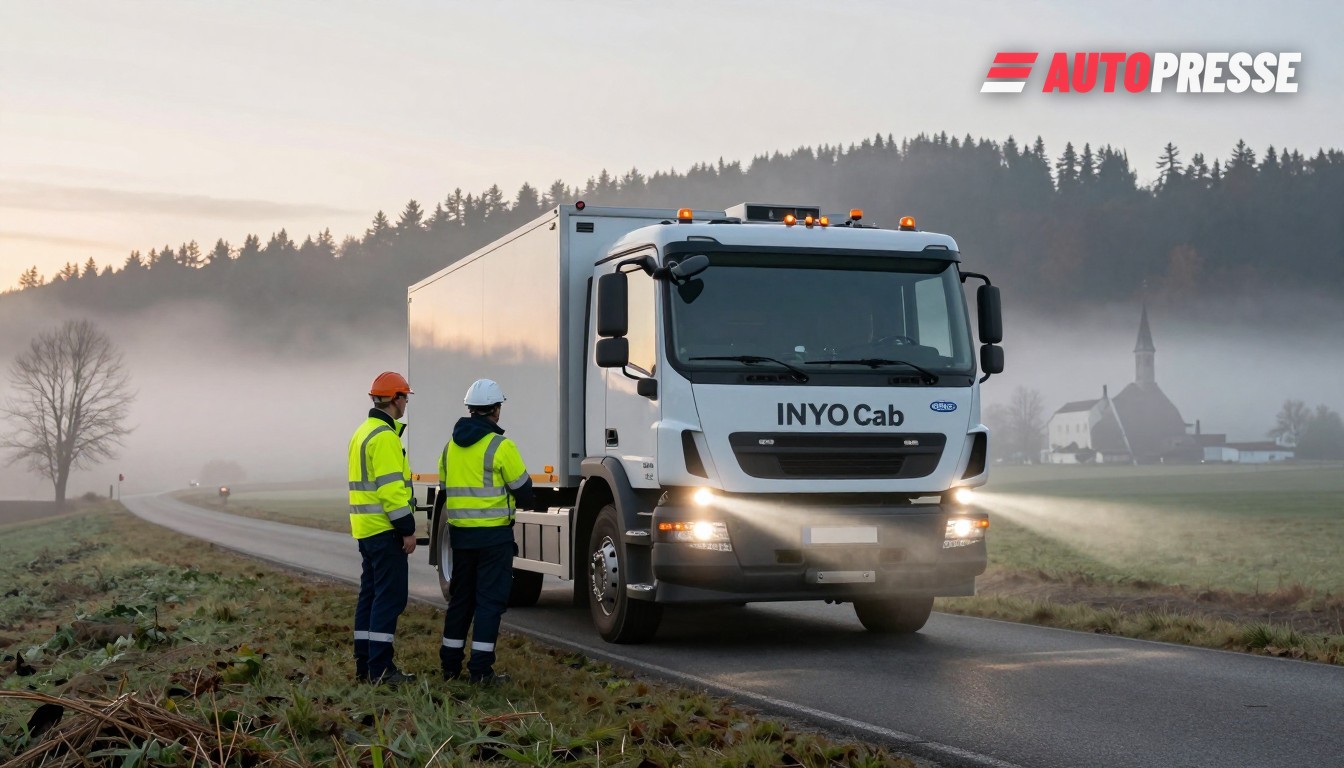
The Grafing‑based start‑up INYO Mobility has begun public test runs of its four‑seat INYO‑Cab — a last‑mile, fully electric shuttle whose autonomy was trained, validated and virtually certified using Ansys (part of Synopsys) toolchains and NVIDIA accelerated computing. The vehicle will be shown in the “Mobility Experience” ahead of the Munich Autonomous Driving Summit on 9 November, underscoring a German small‑enterprise effort to bring robotaxi technology into regional public transport.
How the INYO‑Cab was developed and approved
INYO says it used digital‑twin and sensor‑simulation workflows provided by CADFEM together with Ansys AVxcelerate and other Ansys validation tools to generate physics‑accurate synthetic data and to run safety validation before road tests. CADFEM — a neighbour and investor in INYO — built the INYO‑Cab’s digital twin and supported virtual training, enabling faster iteration and what the company frames as a data‑driven route to regulatory approval.
In an Ansys case study, INYO’s founder Marcus Zwick is quoted saying that the Ansys tools and CADFEM’s application expertise “yielded outstanding results, helping the vehicle obtain approval from the authorities.” The Ansys blog describes how the platform and NVIDIA compute were used to validate the shuttle’s behaviour in German urban traffic conditions.
Local tests and the Munich showcase
The INYO‑Cab is scheduled to be demonstrated on the morning programme of the Munich Autonomous Driving Summit (Mobility Experience) on 9 November; organisers list the Grafing test runs among selected live projects. The startup positions the Cab as a feeder solution for public transport where conventional bus services are uneconomic.
What this means for the market
For German and Austrian cities and regional operators, the INYO‑Cab example shows a concrete path from simulation‑heavy development to limited public deployment without the scale of a global OEM. Using physics‑based simulation, synthetic sensor data and GPU‑accelerated validation can reduce trial costs and speed regulator engagement — important for smaller suppliers and start‑ups that lack large test fleets. If these methods reliably deliver demonstrable safety cases, local transport authorities may accept more pilot projects operated by regional companies, opening procurement opportunities for startup vehicle makers and software vendors.
For suppliers and Tier‑1s in Germany and Austria, ANSYS/Synopsys and NVIDIA’s role highlights where value is shifting: from purely mechanical components to simulation platforms, sensor‑simulation expertise and cloud/GPU compute for validation. That creates demand for local integration partners (like CADFEM), test‑infrastructure and regulatory‑focused engineering services — an opportunity for engineering firms, local cloud providers and specialised software houses.
For drivers and public transport users the immediate effect is small: pilots such as INYO’s are unlikely to replace conventional bus routes overnight. But more local, flexible on‑demand shuttles could improve connectivity in low‑density areas and feed rail and bus networks — if pilots scale and authorities accept virtual validation as part of approvals.
INYO Mobility shuttle readers — WorldTrader24 electric vehicles →
Sources: PresseBox, Ansys
Partner note: AutoPresse technology partner DaVinci AI develops AI solutions for the entire automotive industry – from market and dealer analytics to autonomous AI agents and image and video production.