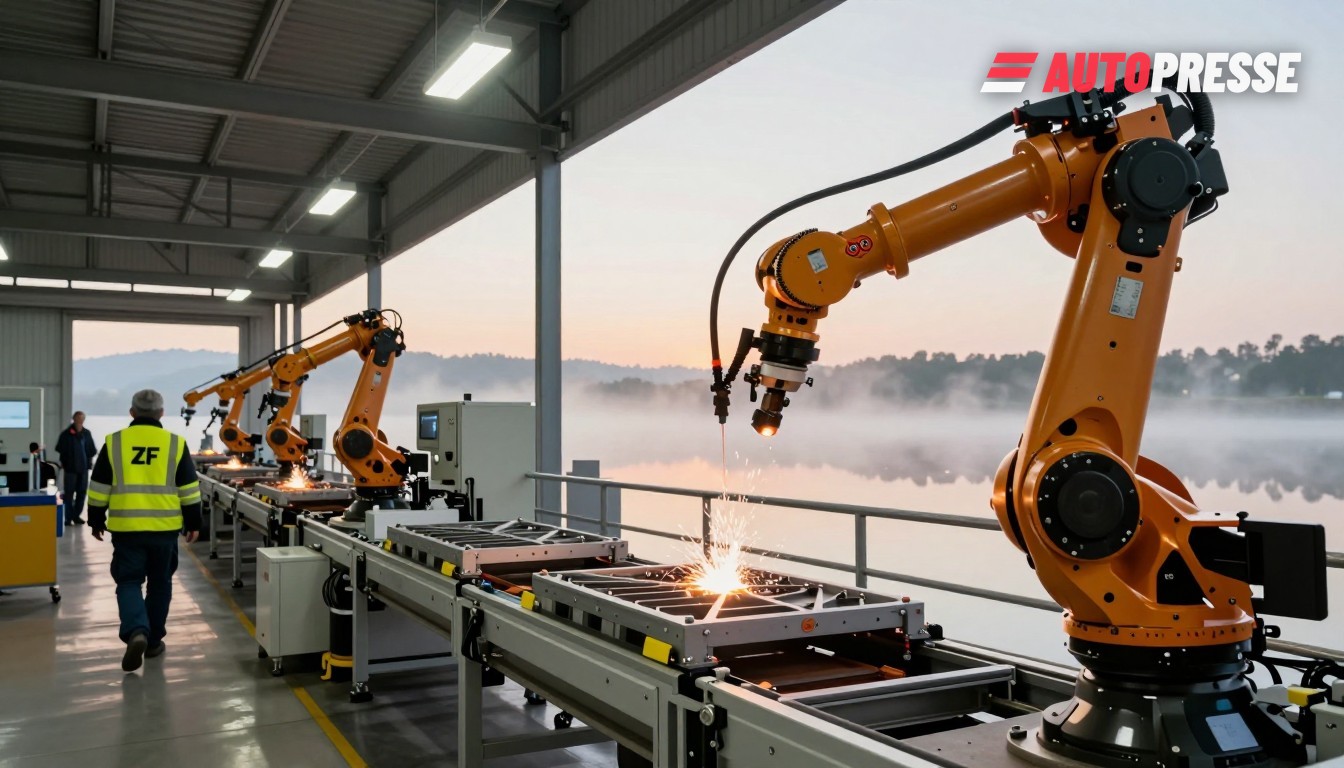
ZF Friedrichshafen and defence‑electronics firm HENSOLDT announced on 18 November 2026 that they have signed a cooperation agreement for series production of the Spexer radar family, with ZF to establish scalable production capacity and develop an automated test system for the line. The signing took place at the Federal Ministry for Economic Affairs and Energy in the presence of Federal Minister Katherina Reiche. This deal places an automotive supplier’s production and test expertise at the heart of a high‑volume electronics line in Germany.
What ZF will do on the line
According to ZF’s press release, the company “is establishing a scalable series production facility for Spexer radars” and will “develop an automated test system for the production process.” The statement adds that ZF will manufacture the radars independently and deliver them directly to customers while intellectual property remains with HENSOLDT. HENSOLDT described the cooperation as part of its strategy to expand capacity through new partnerships and secure supply chains.
Why this matters for factory automation
ZF’s move is notable because it explicitly ties a major automotive supplier’s volume‑production and test engineering skills to high‑frequency electronics manufacturing. Automated in‑line test systems — the kind ZF says it will develop — are part of the same digitisation and quality‑control stack that German car and parts plants have been adopting to reduce rework, speed throughput and increase traceability. Industry work on digital twins, agentic AI for shop‑floor tasks and simulation‑led validation illustrates how manufacturers are combining automation, virtual commissioning and AI‑assisted test and inspection workflows.
What this means for the market
For Europe’s automotive and supplier base, the ZF–HENSOLDT agreement reinforces two trends. First, Tier‑1s with large production and test engineering teams are extending their capabilities into adjacent, electronics‑intensive markets where repeatable, high‑yield production matters. Second, the same tooling and factory‑automation techniques used to tighten quality in car plants — automated test rigs, digital twins and simulation‑based commissioning — are now economically attractive in related electronics and defence lines. That creates opportunities for German plants and system integrators to win contracts that require tight traceability and automated in‑process validation.
Practically, suppliers and plant managers in Germany and Austria should expect stronger demand for systems integrators, industrial test automation and the software that ties shop‑floor telemetry to quality teams. Policymakers and purchasers will also watch whether these projects reduce lead times and warranty risk — outcomes automotive buyers prize when structured into supplier contracts. Broader adoption of automated testing and digital commissioning can lower the time needed to scale new production lines and speed transfer of complex electronics into local manufacturing.
WorldTrader24 B2B vehicle marketplace for dealers →
Sources: ZF Press Center, EuropaWire, Siemens Blog
Partner note: AutoPresse technology partner DaVinci AI develops AI solutions for the entire automotive industry – from market and dealer analytics to autonomous AI agents and image and video production.