Germany and Austria are moving from pilot to rollout for megawatt‑class charging for heavy trucks. New high‑power sites and finalised standards mean commercial fleets can start planning routes where a modern e‑truck can regain operational range during mandatory rest breaks — not overnight only. This matters for drivers, fleets, service operators and regional grid planners across the two countries.
From HoLa on the A2 to Kufstein on the Brenner
Germany’s HoLa project has installed the first public megawatt charging points along the A2 freight corridor as part of a multi‑partner programme coordinated by research institutes and industry; the project’s early sites (Lehre / Lipperland) are already operating with MCS‑capable chargers and live fleet tests.
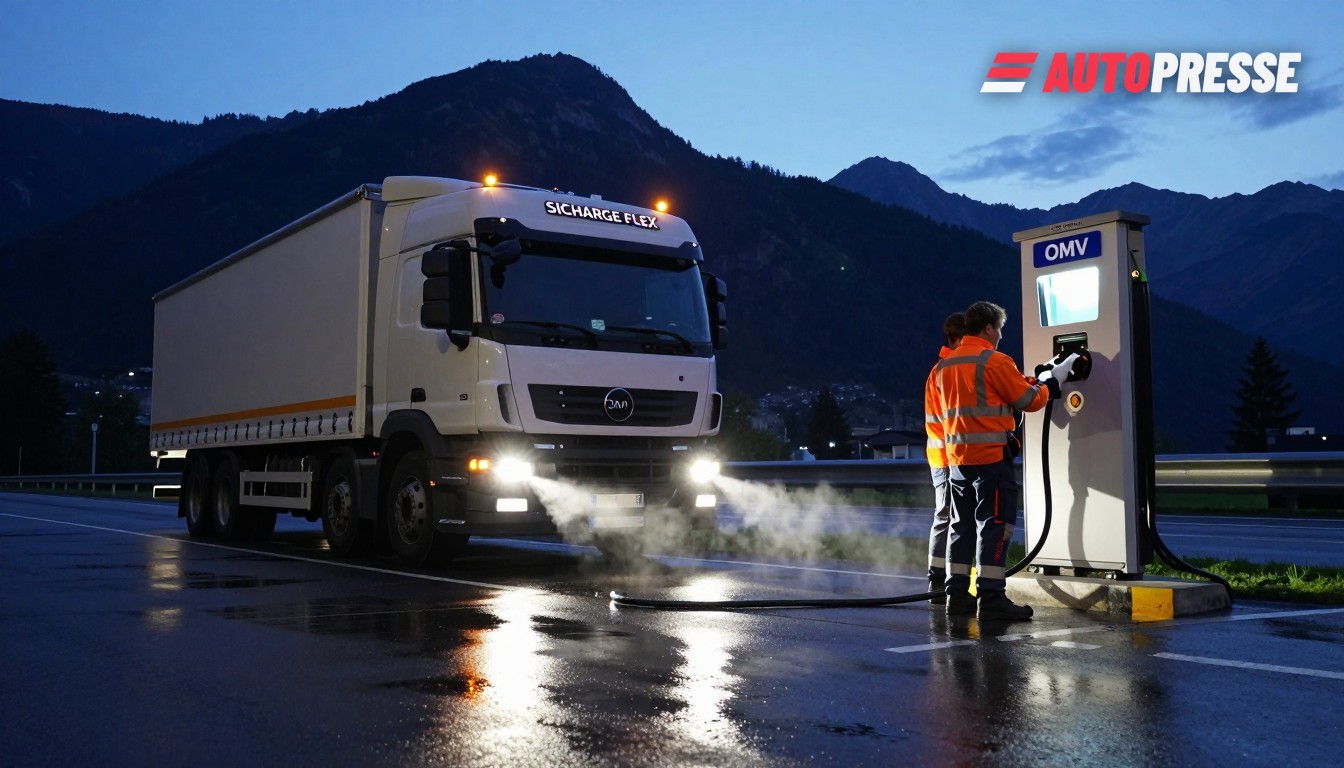
At the same time Austria’s Brenner route has seen one of the first commercial SICHARGE FLEX high‑power truck chargers go into service at an OMV station in Kufstein, with a first phase of two truck charge points operational and a planned expansion to additional 600–1,200 kW MCS bays. The Kufstein installation is explicitly aimed at inter‑European freight on the Brenner corridor.
Standards and demonstrations: the technical bricks are in place
The industry’s technical barrier to megawatt charging has largely been cleared in 2026. The ISO 15118‑20 amendment (AMD1), which adds MCS service profiles and AC‑DER features for secure vehicle‑to‑grid communication, was published in July 2026.
The IEC published IEC 61851‑23‑3 in 2026, the part that specifies DC supply equipment for Megawatt Charging Systems (MCS), completing a core piece of the MCS standards framework and allowing manufacturers and operators to certify hardware to a common specification.
Industry demonstrations at IAA TRANSPORTATION 2026 underlined the practical progress: truck OEMs and charging operators showed MCS charging in live demos and emphasised integrated solutions combining megawatt chargers, local battery storage and reservation/slot systems to make corridor charging dependable.
What this means for the market
Operators and logistics buyers can now plan electrification paths that rely on fast corridor charging rather than depot‑only models. With published standards (IEC 61851‑23‑3 and ISO 15118‑20 AMD1) and live sites in Germany and Austria, truck OEMs, charging‑park builders and energy partners can scale procurement and certification work without awaiting further normative changes. That reduces commercial risk for fleet electrification tenders and for service‑station operators along major trans‑European routes.
Practical limits remain: sites require high grid capacity or on‑site storage, dynamic power management, and verified interoperability between truck, charger and back‑end systems. Early operators are already deploying battery energy‑storage buffers and power‑management software to smooth grid impact and guarantee charging slots for operators.
For drivers and fleets in Germany and Austria, the effect will be tangible: long‑haul electric tractors can factor 30–60 minute high‑power top‑ups into schedules rather than longer depot waits — accelerating the economic case for electrifying line‑haul routes that cross the two countries’ industrial heartlands.
Long-range electric vehicle listings on WorldTrader24 →
Sources: ABB / HoLa project, Siemens / OMV, IAA TRANSPORTATION, IEC/ISO publications