October and year‑to‑date registration releases from national authorities reveal that Germany and Austria are fast-moving but distinct car markets — not merely twins in the same trend. Dealers, fleet managers and municipal planners should note where private buyers, corporate fleets and model demand are diverging, because inventory, servicing and charging planning must follow the customer, not the headline figure.
Numbers and who’s buying
Germany recorded 254,492 new passenger‑car registrations in October 2026; of those, 94,086 were battery‑electric vehicles (BEV), about 37.0% of the month’s market, according to KBA data published in early November 2026. The federal authority also shows that, for January–October 2026, 698,230 BEVs were registered so far (28.2% of the year‑to‑date market), underlining a sizable—and still accelerating—electrified share.
Austria’s October picture differs in structure: 24,174 cars were newly registered in October 2026, including 8,434 BEVs (34.9% of October registrations). Mobility Minister Peter Hanke framed the month as proof that “Austria is on the way to becoming an E‑car country, we must resolutely continue this path!” — a line published with the ministry’s 10 November release. Statistics Austria’s broader series shows that, for January–September 2026, alternative‑drive vehicles accounted for about 66.8% of new registrations (63,172 BEVs in that period).
Two commercial effects stand out: privately registered new cars in Germany rose more strongly in October than company registrations (private registrations were up while business registrations lagged), a split noted in the month’s KBA commentary that matters for financing and residual‑value planning; and in Austria electrified powertrains now make up roughly half of October registrations when PHEVs are included, a structural shift that has immediate implications for used‑car flows and workshop skill sets.
Models and market‑share winners
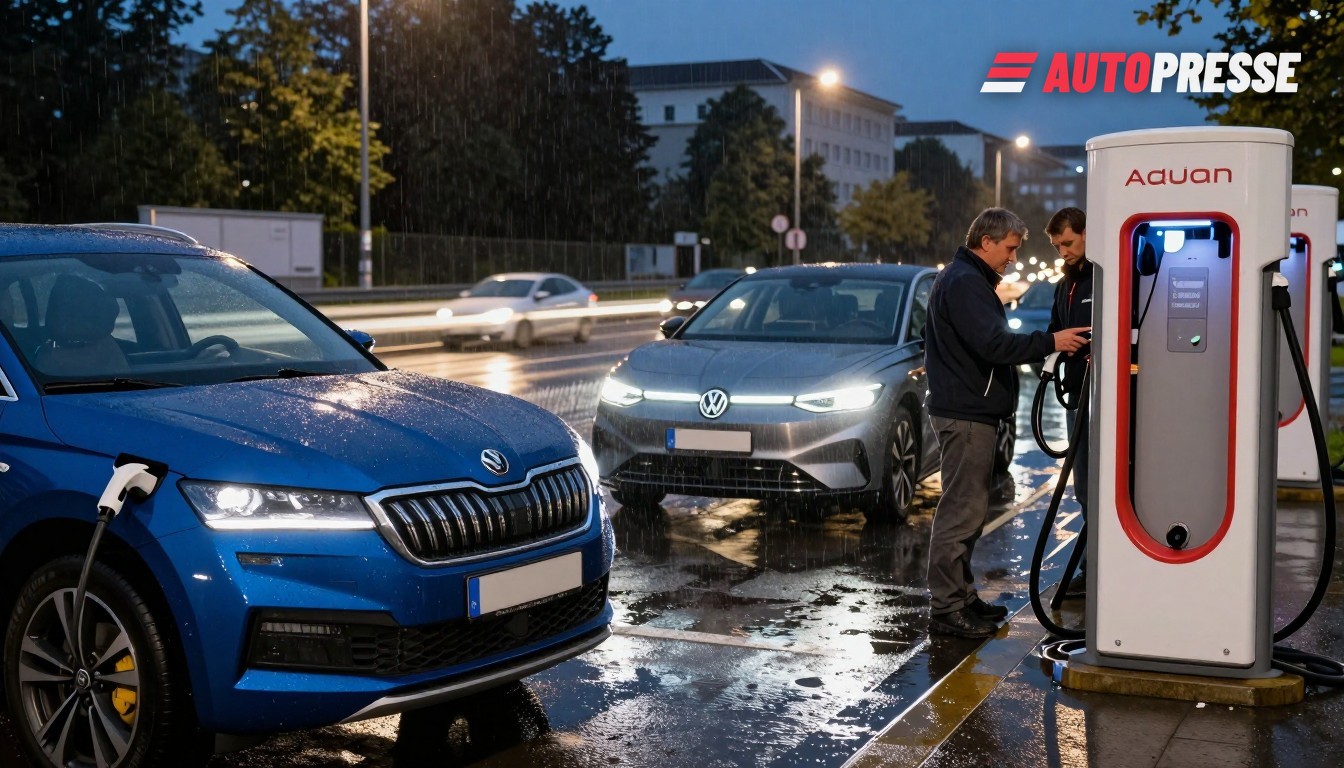
October model lists show an unusual mix: in Germany the Volkswagen ID.7 topped BEV registrations for the month while Škoda’s Elroq leads the year‑to‑date BEV tally — an outcome reflecting both model availability and concentrated fleet deliveries in some segments. The KBA FZ‑10 tables published in early November list the ID.7 and Elroq among the month’s top BEVs. These shifts are already forcing local showrooms to rebalance stock toward compact crossovers and premium electric SUVs which now dominate consumer choice.
What this means for the market
First, dealers must match real demand: private buyers (rising in Germany in October) need competitive private‑sale packages, while slower corporate uptake changes leasing pipelines and residual‑value forecasts. Second, workshops and retailers should accelerate high‑voltage training: the share of electrified cars in both markets means more battery‑service work and fewer traditional‑engine jobs per vehicle. Third, charging and inventory planning must be local and model‑aware — Austria’s continued month‑to‑month BEV strength, and Germany’s larger absolute volumes, require different rollout densities and aftersales investments.
Finally, policy and tax design remain powerful levers: Austria’s public framing and Statistics Austria’s YTD tables show that clear public programmes and information campaigns can tip consumer choice quickly; Germany’s monthly volatility shows how price signals, subsidy timing and fuel costs still move the market fast. Dealers and fleet operators should treat these national differences as operational constraints, not temporary noise.
Electric vehicle listings on WorldTrader24 →
Sources: Kraftfahrt‑Bundesamt (KBA), Austrian Federal Ministry for Mobility (bmimi.gv.at), Statistics Austria, ADAC