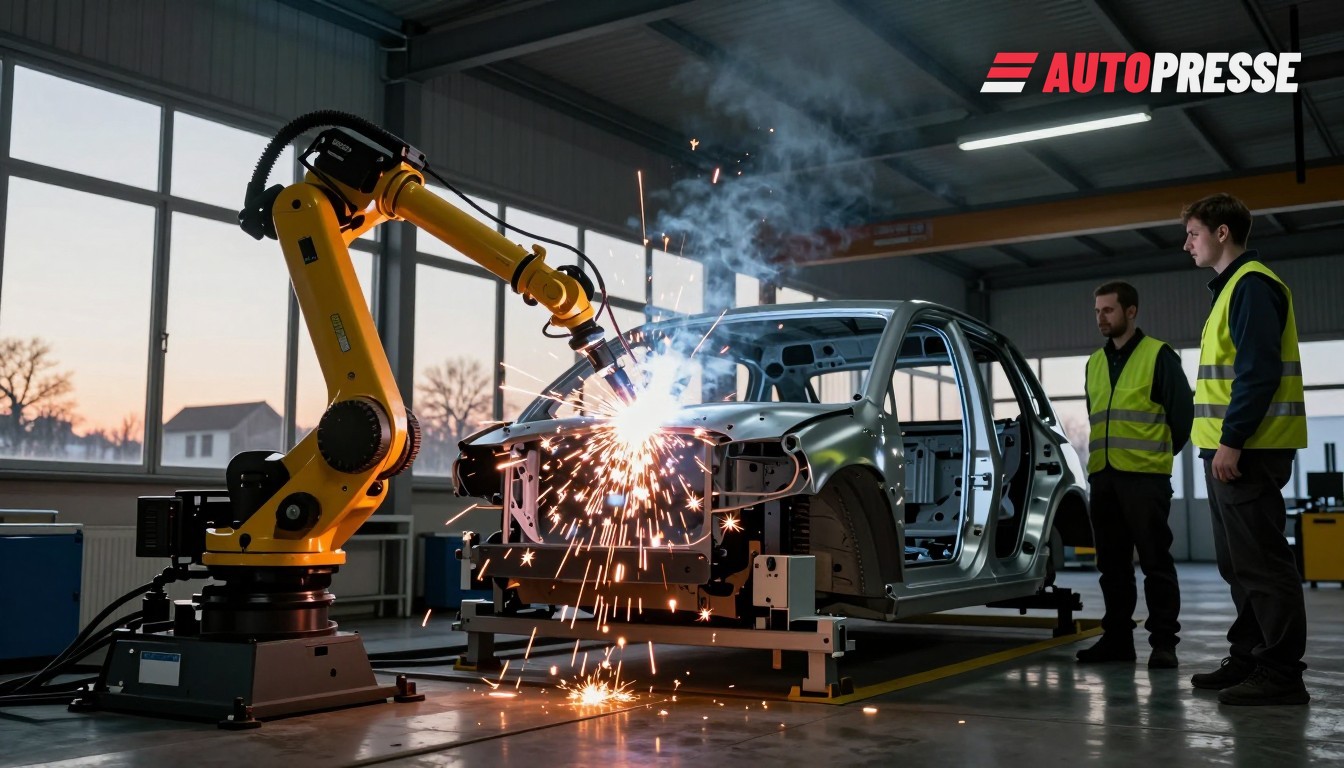
Germany’s and Austria’s automotive suppliers are under renewed pressure from shrinking combustion‑engine demand, tighter bank lending and job cuts — but recent studies and programmes show a clear commercial pivot: more firms are pursuing defence work and ‘Made in Europe’ supply chains to replace lost OEM volumes.
Why suppliers are squeezed
Roland Berger’s Automotive Mittelstandsstudie (21 Sept 2026) finds that more than 70% of European SME suppliers still rely heavily on bank lending, while banks are tightening credit — and warns that many companies “underestimate” their own vulnerability. The authors write that the sector faces a “double task”: defending market position while finding new growth outside a stagnating auto market.
That strain shows in employment and revenue in Austria: ARGE/WKO figures quoted by DerStandard and the ARGE press release report about 73,900 directly employed in the Austrian supplier industry at end‑2025 — roughly 3,000 fewer jobs than a year earlier and a 5.5% fall in supplier turnover to €26.87bn in 2025. Industry spokespeople demanded better location conditions to stabilise the sector.
Credit conditions matter: the Oesterreichische Nationalbank’s Financial Stability Report 52 (11 Nov 2026) highlights elevated non‑performing‑loan risks and stresses that banks have become more selective in sectors exposed to structural change — a headwind for capital‑intensive supplier investments.
Where suppliers are looking for growth
Several policy and education initiatives are already steering suppliers to alternative customers. TU Wien’s analysis (18 May 2026) and its new “Defense Market Readiness” seminar argue that many automotive capabilities — mechatronics, sensors, power‑electronics, production quality systems and lightweight design — are directly transferable to European defence procurement, which is expanding under Re‑Arm and sovereignty programmes. TU Wien lays out practical steps (export‑control, AQAP/IATF certification, pilot subsystems) for suppliers that want to win defence work.
At the same time, Austria’s WKO and regional studies emphasise the upside of ‘Made in Europe’ sourcing and closer industrial co‑operation: export intensity remains high (auto suppliers’ export quotas are cited at roughly 94% in ARGE material), so reshoring and European industrial programmes are seen as tangible market avenues.
What this means for the market
For buyers and dealerships, the short‑term effect will be modest: parts availability remains linked to OEM production, and substitution into defence or industrial markets takes months to certify. For suppliers and employees the consequences are immediate — the sector must invest in compliance, new certifications and longer sales cycles, while also fixing financing gaps Roland Berger highlighted. Private‑equity and alternative capital are rising on the agenda as banks tighten.
Policymakers should note the mix of vulnerability and capability: Austria’s supplier base is export‑strong but cost‑sensitive, and Germany’s Mittelstand shows pockets of over‑optimism about its own resilience. Targeted support for certification, matchmaking with defence primes and easier access to transformation finance (grant, subordinated loans or capital markets) could convert layoffs into re‑skilling and new industrial contracts.
WorldTrader24 B2B-Fahrzeugmarkt für Händler →
Sources: Roland Berger, Statistics Austria, Der Standard, Oesterreichische Nationalbank (OeNB), TU Wien, WKO