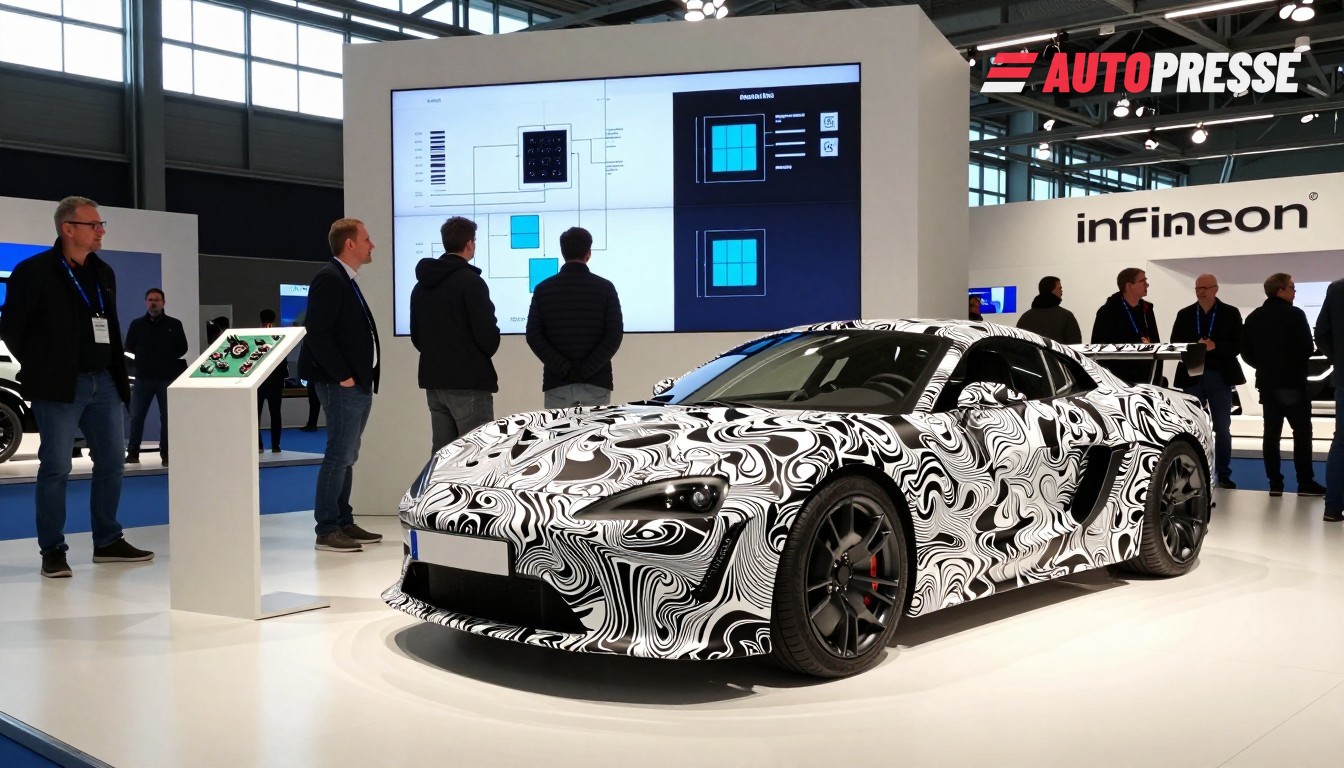
Munich — German chipmaker Infineon this month moved from promise to product concept for in‑vehicle AI: on 4 November 2026 it announced the AURIX RC1 microcontroller family and showed the concept at the electronica trade fair in Munich (10–13 November 2026). The new platform is explicitly positioned to run real‑time, edge and "Physical AI" workloads inside vehicles — a step that matters for OEMs, suppliers, dealers and workshops that will need on‑vehicle compute to run more intelligent driver aids, diagnostics and domain controllers.
What Infineon announced
Infineon described AURIX RC1 as its first MCU platform to leverage the open RISC‑V instruction set and said the family scales from classic microcontrollers to hybrid microcontroller/microprocessor devices. The company told press that the family will simplify zonal and domain consolidation for software‑defined vehicles (SDV) and support on‑device AI use cases; samples are targeted for the first half of 2027.
In its release Infineon noted the product will be presented at electronica (Messe München, 10–13 November 2026) and highlighted the link between higher edge compute and tighter safety, security and real‑time requirements for automotive control. A short Infineon line summarises the strategy: "AURIX RC1 is Infineon’s first MCU platform that leverages the benefits of RISC‑V."
Toolchains and development: virtual prototypes arrive
Crucially for German engineering teams, Synopsys announced on 10 November 2026 that it will deliver a Virtualizer Development Kit (VDK) for the AURIX RC1 family — a virtual prototype that lets software teams build, verify and validate vehicle‑level and Physical‑AI applications before silicon samples arrive. Synopsys’ VDK was presented during the electronica window and is intended to shorten integration cycles for OEMs and Tier‑1s.
Multiple industry outlets covering electronica reported the same timeline and stressed that the RC1 concept is designed to bring real‑time Ethernet switching, zonal compute and edge AI acceleration into a single MCU family — a consolidation that both simplifies E/E architectures and raises the stakes for software toolchains.
What this means for the market
For German and Austrian OEMs and suppliers the announcements close an important technical loop: hardware capable of running low‑latency AI workloads on‑board is now paired with virtual engineering tools that cut integration risk and speed testing. That reduces the time between concept and vehicle‑integration, and it puts more autonomy in the hands of vehicle software teams — with obvious consequences for calibration, workshop diagnostics, OTA update strategies and the skills dealers must carry. The RC1 timeline (samples H1 2027) and Synopsys’ VDK (announced 10 Nov 2026) mean engineering programmes can start system‑level work now rather than waiting for hardware.
Short term, dealers and workshops should expect richer diagnostics data and new update flows; mid term, zonal and domain consolidation will change parts sourcing and repair procedures. For suppliers the message is clear: edge AI and real‑time compute are moving from lab demos to production roadmaps in Germany.
WorldTrader24 B2B-Fahrzeugmarkt für Händler →
Sources: Infineon Technologies, Synopsys, MarkLines