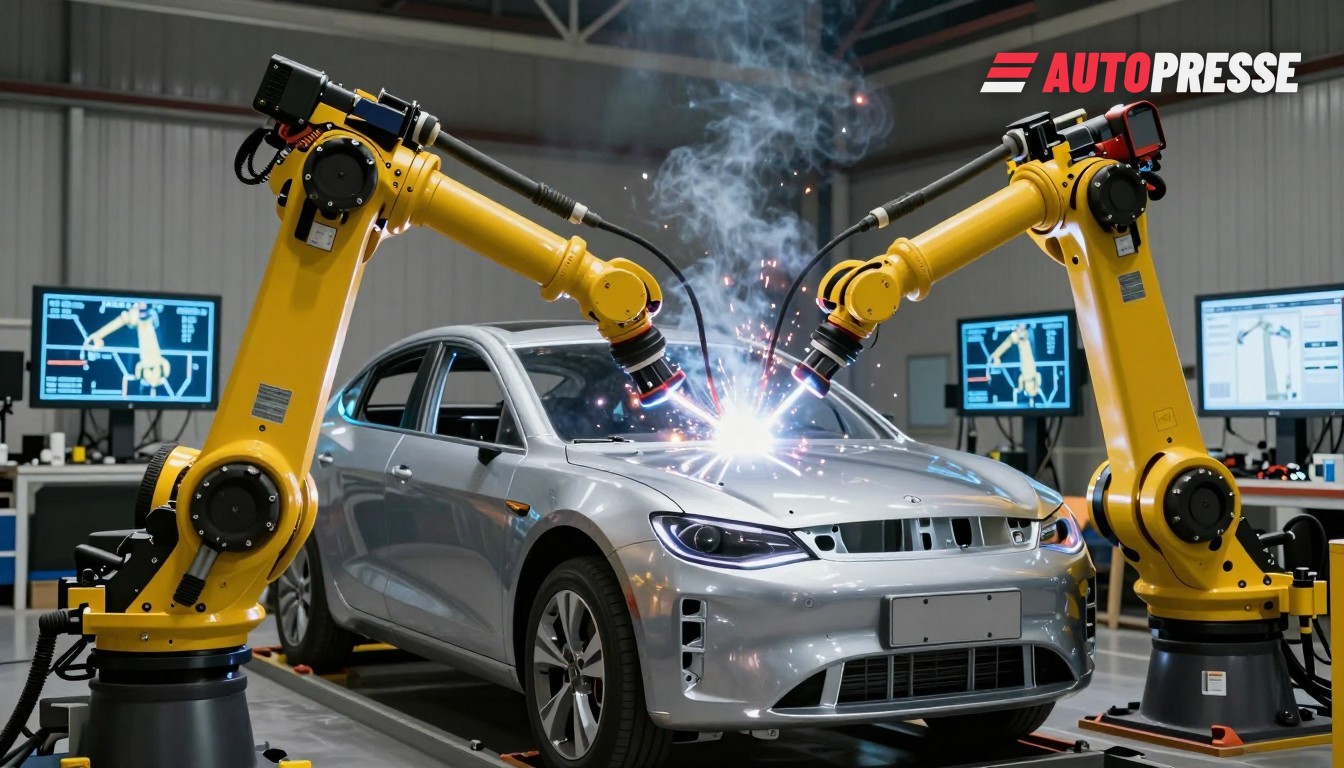
A major automation order landed in Germany this week when ABB Robotics announced on 11 November 2026 that it will supply more than 1,700 large industrial robots to the BMW Group for the Neue Klasse body‑shop lines in Munich (Germany) and Tiexi (Shenyang, China). The deal underlines how AI‑ready automation is moving from pilots into full‑scale car production — a development that matters to plant workers, suppliers and the thousands of technicians who service modern body shops.
The deal and the technology
ABB’s press release specifies the scope and machine family: the delivery covers IRB 6720 through IRB 6740 and the heavy‑payload IRB 7720 models, with payloads up to 620 kg, all running the OmniCore™ controller platform. ABB says OmniCore supports integration of AI, sensors, cloud and edge technologies and includes energy‑recovery features; the company also highlights reduced commissioning times and up to 20% rated energy savings from the platform. Joerg Reger, Automotive Business Line Manager at ABB Robotics, described the collaboration as “a shared vision of flexible and future‑proof production.”
Manufacturing and AI in practice
BMW has been explicit that the Neue Klasse programme pairs heavy automation with AI‑assisted quality and logistics. In a BMW press dossier from 2 April 2026 the company detailed its Munich transformation — a €650 million upgrade — where a new body shop uses 800 industrial robots for joining tasks and automated surface inspection (ASI) systems that employ cameras and artificial intelligence to detect paint and surface deviations. BMW’s Milan Nedeljković said the company had “invested heavily in technologies, digitalisation and AI.” Those AI‑assisted inspection and digital‑twin systems are the operational counterpart to ABB’s robot and controller delivery.
What this means for the market
Two things are clear for Germany and the region: first, industrial AI is now embedded in mainstream vehicle production rather than confined to labs and pilot lines; second, factory automation remains an important demand driver for robot and software suppliers. For suppliers and aftermarket firms this raises demand for skilled commissioning engineers, robot‑trained maintenance teams and AI‑capable inspection services. For dealers and service networks the implication is steady growth in the sophistication of repair‑shop tooling and diagnostics as more vehicle and factory systems move to software‑defined, AI‑instrumented workflows.
The ABB order also shifts attention to integration and data governance: OmniCore’s pitch is tighter orchestration of edge controllers, sensors and higher‑level IT — exactly the areas where suppliers and integrators will compete to provide secure, reliable AI stacks that keep production running. The short‑term winners will be companies that can combine on‑site robotics expertise with secure, low‑latency AI orchestration.
In practical terms for workers the move promises safer, less‑physically taxing tasks, and for OEMs measurable gains in precision, energy use and defect detection. ABB and BMW’s published figures — the 1,700+ robot order (ABB, 11 Nov 2026) and Munich’s 800‑robot body shop and €650m plant modernisation (BMW, 2 Apr 2026) — make this a concrete industrial step, not a hypothetical roadmap.
Shortly, AI‑ready robots and AI‑assisted inspection will become routine in German vehicle plants; the focus will move to commissioning, integration and the skills ladder that keeps lines productive and compliant.
Solutions such as those offered by DaVinci AI (davinci‑ai.ai) can help exactly here: multi‑agent dealer and workshop assistants, market and stock analytics, and autonomous agents that manage routine scheduling and data flows reduce the operational load on plant IT and dealer networks while improving lead times for parts, bookings and campaign responses. For manufacturers and dealer groups, agentic systems that remember context and automate repeat tasks shorten reaction times and free engineers to focus on complex integration work.
WorldTrader24 B2B vehicle marketplace for dealers →
Sources: ABB, BMW Group