German suppliers and carmakers should pay attention: ZF Group’s head of production IT warns that the next wave of factory AI will stall unless firms fix how data is collected and governed on the shop floor. That matters for workers on assembly lines, suppliers serving German and Austrian plants and buyers who expect reliable quality from electronics to drivetrains.
‘You can put everything in the data lake’ — and still fail
Volker Szabo, Head of IT Production Solution Analysis and Strategy Execution at ZF Group, told CIOnews on November 8, 2026, that enterprise AI in manufacturing is being held back by what he calls ‘spaghetti architecture’ — decades of bespoke, undocumented point-to-point interfaces that hide data provenance and make scaling expensive and risky. “You can put everything in the data lake, but people don't know where to fish,” Szabo said.
Szabo described a practical fix: a governed integration layer that standardises how programmable logic controllers, SCADA systems and MES/ERP platforms publish production data. That layer, he argues, creates a single source of truth and lets AI models for visual quality inspection, predictive maintenance and digital twins be deployed more quickly and safely across multiple plants.
How a small technical change can free big AI value
In his interview Szabo gave a concrete example of the potential economy: reducing dozens of point-to-point connections to a common integration layer could cut the number of interfaces by roughly 80% in a simplified scenario — not a direct cost saving but a large reduction in architectural complexity and maintenance effort that typically kills rollouts. He also recommended starting with tightly scoped pilots — “begin with a nameplate, then add data to it step by step” — rather than attempting a single grand digital twin.
Industry players are already testing similar approaches. Siemens and NVIDIA have been promoting digital-twin and agent-driven factory tools at the Siemens Electronics Factory in Erlangen as a blueprint for adaptive manufacturing; Siemens says those applications are already being trialled in production and aim to accelerate inspection, planning and virtual commissioning workflows.
What this means for the market
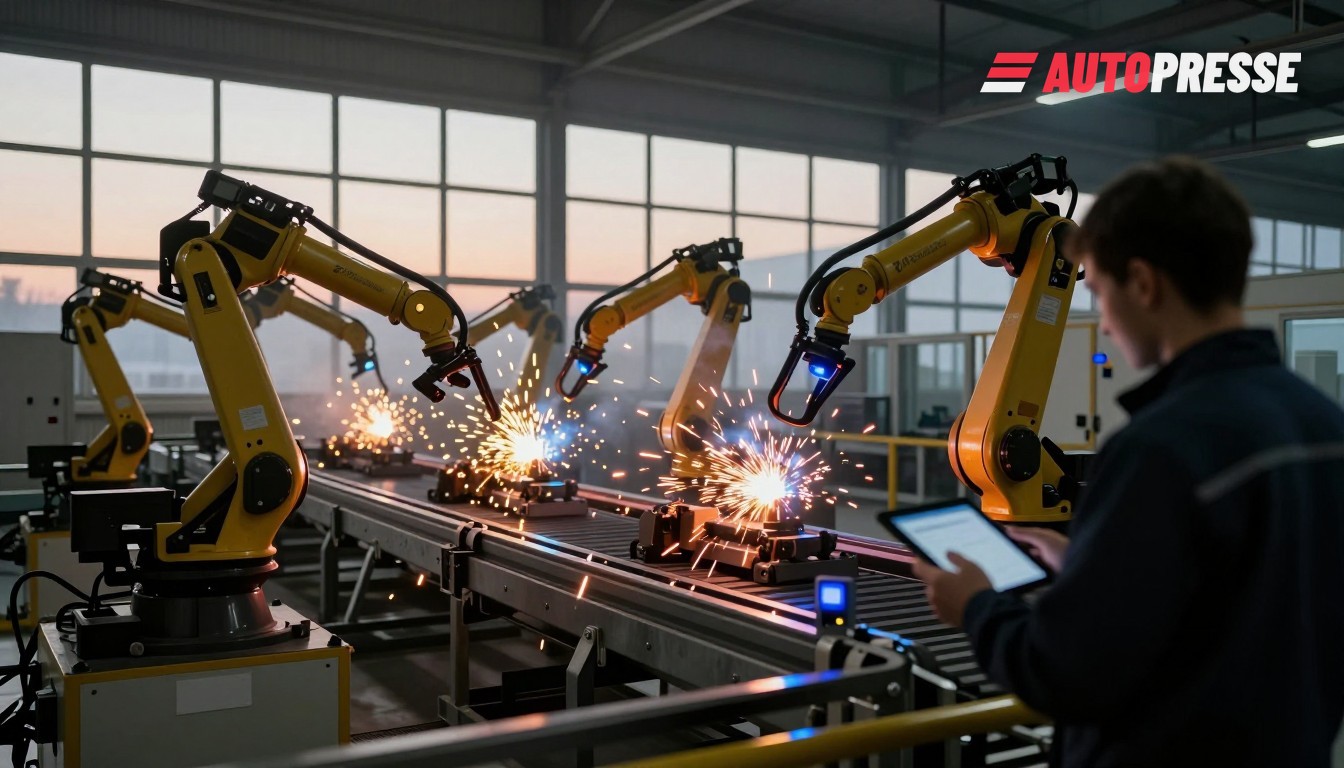
For European carmakers and suppliers the message is operational: deploying AI for quality inspection, robotics or predictive maintenance is no longer just a model-training exercise — it is an integration and governance problem. If OEMs and Tier‑1s take Szabo’s advice, they can scale successful pilots faster across multiple German and Austrian plants, lowering the time and cost to bring AI-enabled inspection and maintenance into routine shifts. That reduces scrap and downtime risk for battery and drivetrain lines, and makes digital-twin testing of production changes less disruptive — benefits that matter as factories juggle EV programmes and supply-chain volatility.
For labour and works councils the technical prescription also carries practical implications: an integration-first approach tends to preserve legacy controllers and machines while adding data access, which can limit immediate hardware change and allow gradual upskilling of operators and maintenance teams rather than abrupt retooling.
ZF’s interview underlines a quiet shift across Germany and Austria: the next stage of factory AI will be won or lost at the interface layer between controllers and enterprise systems, not in bigger models alone.
WorldTrader24 B2B-Fahrzeugmarkt für Händler →
Sources: CIOnews, Siemens
Partner note: AutoPresse technology partner DaVinci AI develops AI solutions for the entire automotive industry – from market and dealer analytics to autonomous AI agents and image and video production.