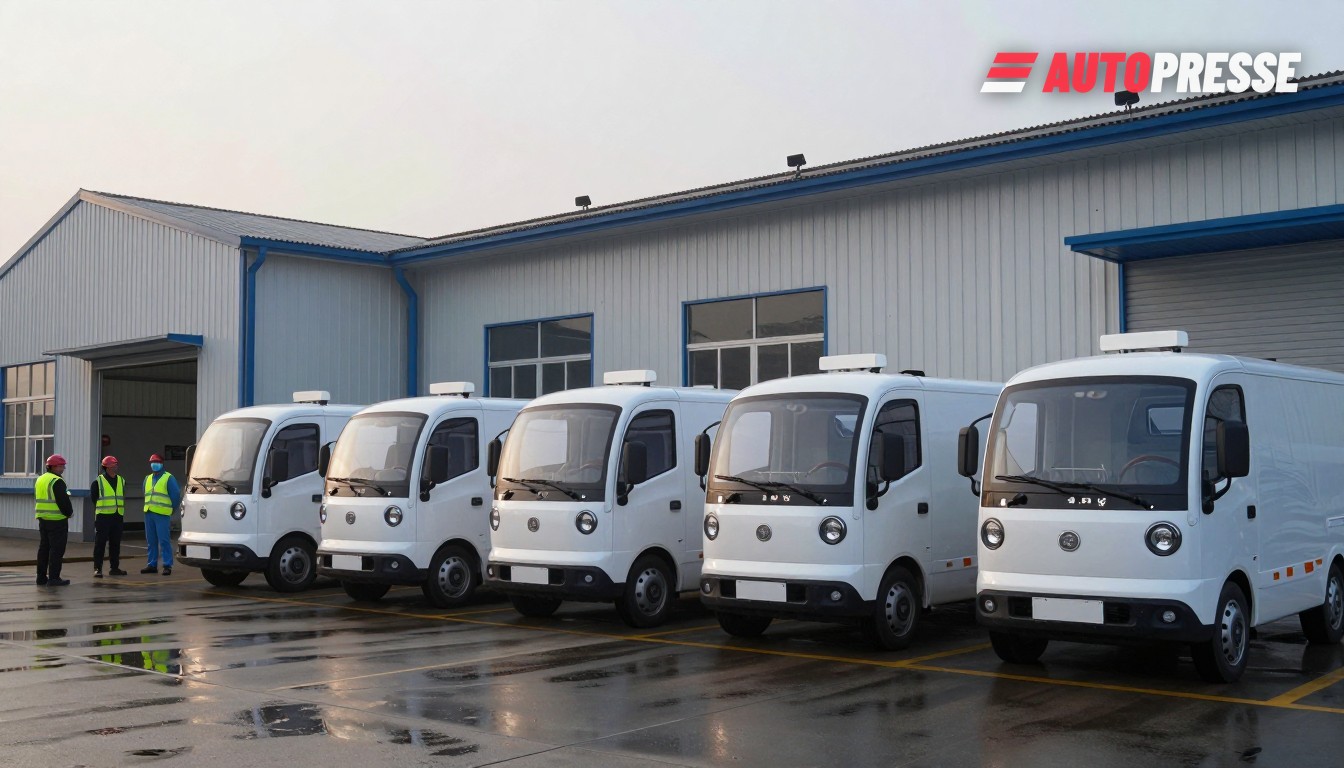
Drivers, logistics managers and plant employees in Bavaria woke up to a visible step change in automation this week: four cab‑less autonomous electric trucks from Swedish technology firm Einride have entered regular service on the private grounds of snack maker Lorenz Snacks in Neunburg vorm Wald. The vehicles will move production goods and empty pallets between lines and the central warehouse under a five‑year transport service agreement, the partners said.
Project details: vehicles, capacity and operations
The deployment uses four purpose‑built, cab‑less Einride rucks that carry Euro‑pallet loads; each vehicle has a loading capacity of 15 pallets and is coordinated via Einride’s Saga AI platform, with remote and local operators monitoring operations. Partners say a single round route takes roughly 30–45 minutes and the setup can move up to about 1,200 pallets a day during normal operations. The fleet is complemented by two conventional electric trucks as a backup to ensure continuity. The project was presented on site in early November 2026.
Lorenz and Einride describe the five‑year arrangement as a transportation service agreement: Einride owns and operates the vehicles while the snack manufacturer integrates autonomous runs into everyday plant logistics. The vehicles are charged on‑site using electricity from Lorenz’s photovoltaic system, the companies said.
Regulatory and operational context
Lorenz’s PATHFINDER concept — which won third place at the 2026 German Logistics Awards — is not a short trial, the partners emphasise, but a permanent operational change to reduce CO₂ emissions from internal transport and to scale autonomous solutions inside industrial sites. Einride staff noted the operation was developed in close contact with German authorities and testing organisations to create an operable blueprint for use at other sites.
What this means for the market
The Lorenz–Einride rollout signals that autonomous, AI‑coordinated freight is moving from pilots into durable industrial use in Germany. For OEM suppliers, Tier‑1 software vendors and EV integrators, on‑site autonomy projects reduce the technical and regulatory hurdles posed by public‑road robotaxi services while still scaling sensor, compute and fleet‑management know‑how. Plant operators in Germany and Austria can view such projects as immediate productivity and sustainability measures: they lower diesel use, centralise scheduling with AI and create repeatable templates for other manufacturing sites. At the same time, the model — vendor‑owned vehicles operated under service contracts — points to new commercial relationships between manufacturers, logistics tech firms and plant operators rather than outright vehicle purchases.
Industry observers should watch two things: whether the model spreads beyond niche uses into broader intralogistics across German and Austrian car plants, and how quickly suppliers for sensors, E/E architecture and on‑site charging scale to meet growing demand. If replicated, the approach could pull more software and AI spend into European supply chains while reshaping operational roles on the factory floor.
B2B vehicle listings on WorldTrader24 →
Sources: Presseportal, electrive
Partner note: AutoPresse technology partner DaVinci AI develops AI solutions for the entire automotive industry – from market and dealer analytics to autonomous AI agents and image and video production.