Germany’s and Austria’s automotive chains are quietly shifting from tooling‑heavy supply lines to flexible, on‑demand production — and that matters to drivers, dealers and plant managers facing long lead times for parts. Recent moves by tier‑1s, service bureaus and trade associations show additive manufacturing (AM, or 3D printing) moving from prototype lab to factory floor, offering faster spares, lower inventory and new local suppliers for OEMs and workshops.
Proofs and capacity: machines, deals and alliances
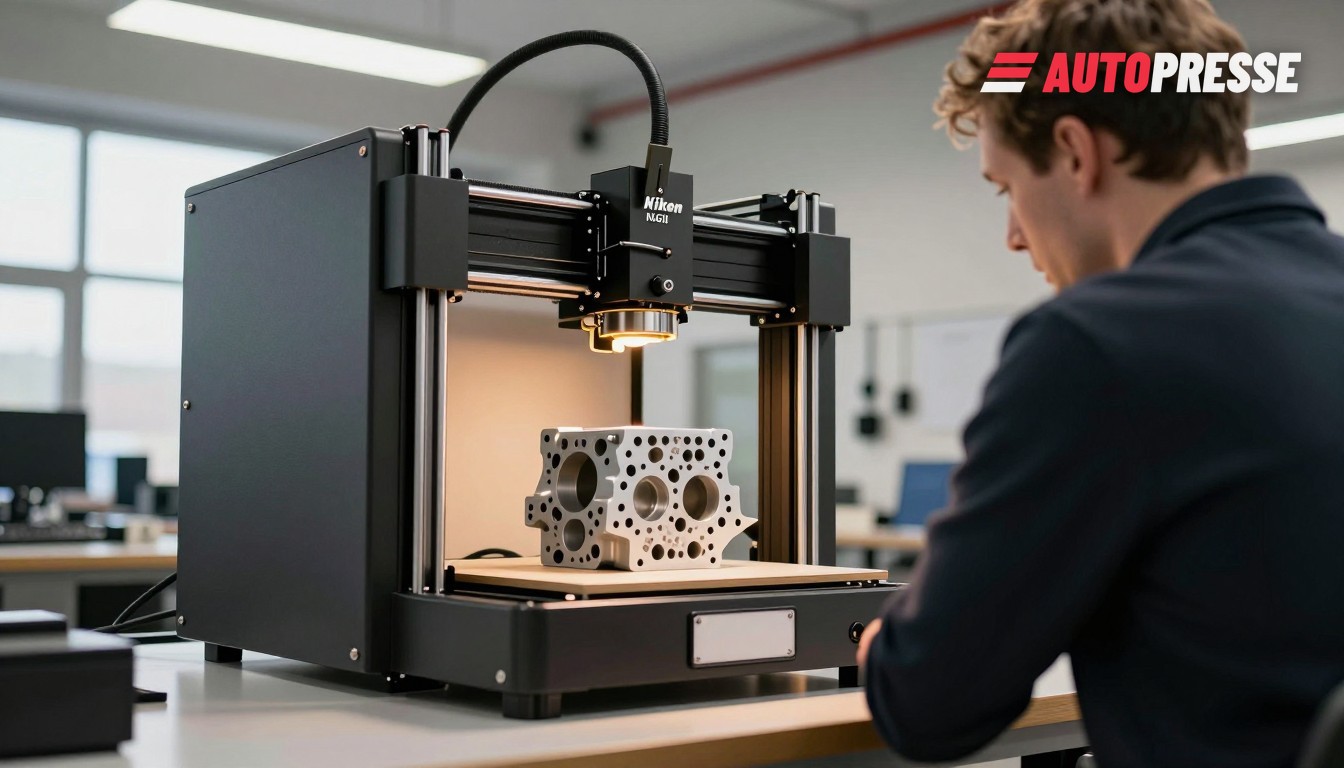
On 19 August 2026 Bosch’s Additive Solution Center in Nuremberg demonstrated the technology’s potential by 3D‑printing a single‑piece aluminium V8 engine block on a Nikon SLM NXG XII 600 — a technical demonstrator the partners say proves AM can reach complex, high‑value automotive applications and reduce tooling lead times.
Smaller service providers are following: Stuttgart‑based Cirp upgraded polymer SLS capacity with a TPM3D S480 to support functional automotive parts and small‑series runs, underlining a shift from prototyping toward repeatable production. The Cirp upgrade was announced on 22 July 2026.
Industry consolidation and market building are accelerating too. On 14 September 2026 Bechtle Additive Manufacturing Deutschland completed an asset acquisition that strengthens its HP‑based 3D printing footprint across Germany and Austria, signalling growing commercial scale in the DACH AM market.
At the network level, German association Verband 3DDruck and Austria’s AM‑Austria agreed in August 2026 to deepen cooperation, creating cross‑border working groups and shared events to speed industrial adoption. "Additive manufacturing has long since become more than just a single technology," the release quoted — a line that frames the partnership’s aim to bind research, suppliers and users across both countries.
Market scale and momentum
The scale behind these moves is not trivial: Germany’s industrial 3D‑printing market was valued at roughly €2.4 billion in 2025 and continues to show strong growth, with serial production, spare‑part printing and tooling among the fastest‑growing segments. That industrial footprint makes the region fertile ground for automotive AM to scale.
What this means for the market
For drivers and workshops: faster access to hard‑to‑find parts and fewer weeks‑long outages when legacy tooling is gone. For dealers and fleet operators: the opportunity to source low‑volume, high‑value components locally rather than wait for cross‑border shipments. For suppliers and plants: AM opens new business models — paid printing services, digital inventories and on‑demand small‑batch production — that lower inventory cost and shorten development cycles.
There are caveats. Demonstrators such as Bosch’s V8 block prove capability but do not mean immediate series‑wide adoption: qualification, cost per part, materials and quality control remain hurdles. Still, the combination of tier‑1 experiments, service‑provider upgrades and industry association alignment suggests a clear, practical pathway from pilot projects to deployed production tools over the next two‑to‑five years.
WorldTrader24 B2B vehicle marketplace for dealers →
Sources: TCT Magazine, AM‑Austria, Bechtle, TPM3D, 3D On Demand