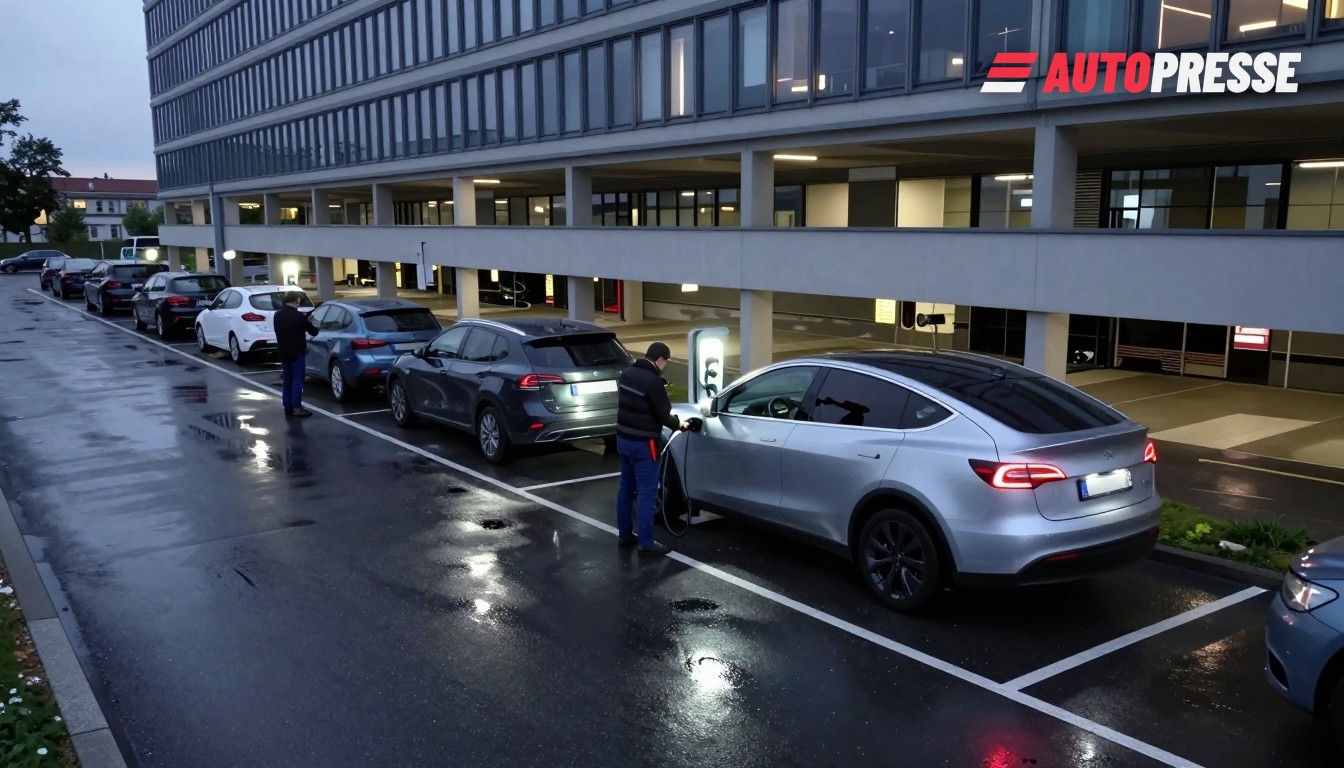
Germany and Austria face a fast‑arriving set of legal changes that will reshape where chargers appear, how electric vehicles can feed power back to the grid, and how quickly grid operators must react. For drivers, fleet managers and property owners the deadlines are concrete — and they are close.
What has changed in Germany (and why it matters)
In July 2026 the Bundestag and Bundesrat completed an amendment to Germany’s Building Electromobility Infrastructure Act (GEIG), tightening obligations for parking at non‑residential buildings: owners of existing non‑residential buildings with more than 20 parking spaces must meet new charging or cabling targets from 1 January 2027. The amendment lets owners comply either by installing physical charge points or by equipping at least 50% of spaces with pre‑cabling / conduit infrastructure, and creates a compliance route based on total charging capacity rather than pure charger counts.
At the same time Germany’s market‑integration rules for storage and charging were clarified by a Federal Network Agency decision (MiSpeL) adopted 1 October 2026 and effective 21 October 2026: bidirectional (V2G) charge points are now treated on a par with stationary storage for the purposes of levies and network charges. Coupled with earlier Energy Industry Act changes that ended a double‑charging burden for feed‑back power (published December 2025), the MiSpeL ruling materially improves the business case for commercial V2G and fleet services.
Austria: EU pressure and a transposition gap
The European Commission has moved to enforce the recast Energy Performance of Buildings Directive (EPBD): in mid‑2026 the Commission opened infringement procedures and sent letters of formal notice because Member States — including Austria and Germany among others — had not fully communicated national transposition measures by the 29 May 2026 deadline. That EU action puts Austria under clear pressure to publish national rules that implement the same building‑and‑parking charging duties the EPBD requires.
Austria therefore faces a choice that German owners already confront: either install active charge points or invest in cabling and smart charging preparedness now, or risk compressed timelines and potential enforcement steps from Brussels if national rules lag. Guidance published by EU bodies sets the same 1 January 2027 benchmark for existing non‑residential buildings with more than 20 spaces, so the practical window for large operators is the coming weeks and months.
What this means for the market
Short term, property owners, large employers and retailers in Germany must decide between physical chargers and future‑proof pre‑cabling before 1 January 2027 — a change that will drive immediate procurement for installers, cabling firms and smart‑charging backends. The MiSpeL ruling (effective 21 October 2026) makes V2G commercially plausible for fleets and charging operators because feed‑back energy will not carry a double network‑charge penalty; that improves ROI models for commercial vehicle fleets and depot charging projects.
For Austria, continued delay in transposition risks abrupt regulatory catch‑up and project uncertainty. Owners and charging network investors should track national implementing acts closely and prepare for the same technical standards (smart charging, pre‑cabling and interoperability) to be required — both AFIR (EU charging targets) and the EPBD provisions will intersect in practice. Meanwhile grid planners are being pushed to accelerate approvals: Germany debated a Flexibility Acceleration Act in early November 2026 aimed at faster planning and permission processes for grid assets and large consumers, a sign that regulators expect a surge in new connection requests.
In short: installation queues, higher demand for qualified electricians, and a sharper commercial market for V2G services are likely through 2027. Real‑estate owners who act now — by deciding charger counts, cabling scope and smart‑charging requirements — will avoid rushed retrofits and capture early revenues from fleet and workplace charging contracts.
Electric vehicle listings on WorldTrader24 →
Sources: European Commission, Bundesnetzagentur, Gleiss Lutz, EVSE Group, MTR Legal