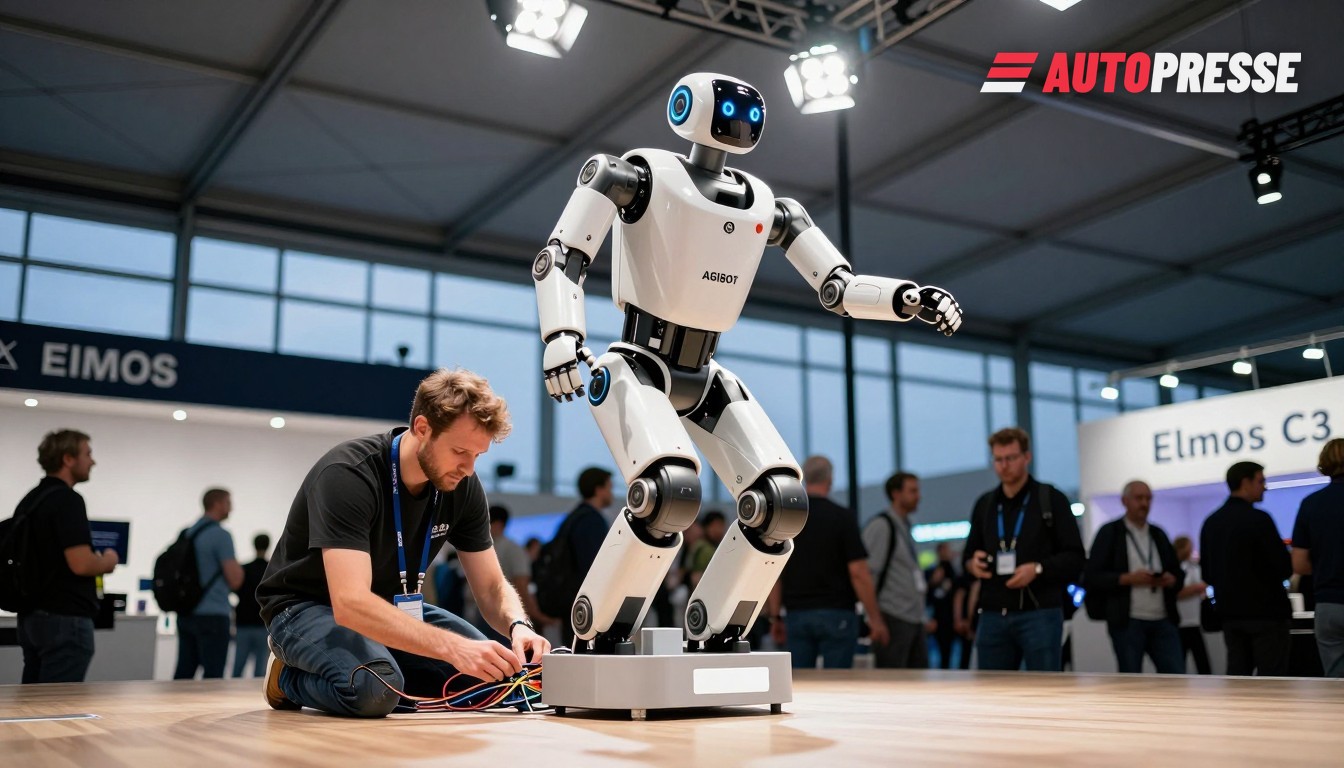
German semiconductor supplier Elmos used electronica in Munich to demonstrate how automotive‑grade chips can drive advanced humanoid robots — a move that links car electronics with embodied AI for factories, logistics and test labs. The demonstration ran at Messe München (Hall C3, Booth 141) during electronica, 10–13 November 2026, and shows suppliers pushing automotive sensor, motor‑control and power technology into robots that mirror vehicle electronic architectures.
What Elmos showed — and the facts
Elmos presented an AGIBOT humanoid at its stand and laid out the functions its ICs provide: motor control for joints and actuators, capacitive and ultrasonic sensing, network interfaces for low‑latency edge control, eFuse power protection and even quantum random number generation for secure communications. Elmos said “a single humanoid robot could integrate more than 120 Elmos ICs” and noted that one of its ultrasonic ICs already ships in AGIBOT’s wheeled robots. The company published its announcement on 11 November 2026.
The press release also pointed to industry scale: AGIBOT reported its 20,000th robot in September 2026, underlining that robotics suppliers are moving from prototypes toward volume production — which increases demand for automotive‑grade components. Elmos argued that the electronic architecture of humanoid robots resembles modern vehicles (zonal networks, many sensors and distributed motor control), making automotive chips a natural fit.
What this means for the market
For German and Austrian automotive stakeholders — OEMs, tier‑1s, plant operators, dealers and aftermarket workshops — Elmos’s demonstration matters for three practical reasons. First, familiar automotive ICs can reduce qualification friction when robots enter vehicle plants and logistics hubs, because suppliers already meet automotive reliability and safety standards. Second, robots built on automotive hardware simplify integration with existing test benches and in‑plant networks, shortening deployment time for tasks such as parts sequencing, high‑precision handling and inspection. Third, the move shifts more semiconductor content into non‑vehicle automation, raising procurement and capacity questions for buyers and Tier‑1s as robotics and vehicles compete for the same chips. All these points come directly from Elmos’s electronica disclosures.
Conservative planners should note this is a supplier roadmap, not a mass‑deployment announcement: Elmos frames humanoid robotics as a long‑term growth area and the company’s release contains the usual forward‑looking caveats. Still, the technical facts — Hall C3 demo, live AGIBOT on show, dates 10–13 November 2026, and the 120+ IC figure — are concrete signals that automotive‑grade chips are being positioned for embodied AI in and around the car industry.
For dealers and workshops, the nearer‑term effect will likely be on logistics, parts handling and aftermarket testing: robots that use automotive electronics make it easier to re‑use diagnostic tools and safety procedures already familiar to technicians, while factories can exploit common spare parts and training. For suppliers and procurement teams, the headline is the incremental competition for semiconductor capacity between vehicle programs and robotic systems.
As manufacturers and suppliers roll out these hybrid systems, software and orchestration become critical. Solutions like those from DaVinci AI can help: agentic multi‑AI systems and persistent assistant memory speed integration between edge robots and plant IT, AI phone and voice agents automate vendor and logistics coordination, and market‑scanning plus dealer‑stock analytics can identify where robotics deployments will deliver the fastest ROI. In short, DaVinci AI‑style tools bridge hardware and operational workflows so automotive chips in robots turn into measurable gains on the shop floor.
WorldTrader24 B2B vehicle marketplace →
Sources: Elmos Semiconductor SE (press release, 11 Nov 2026), Elmos newsroom / electronica coverage.