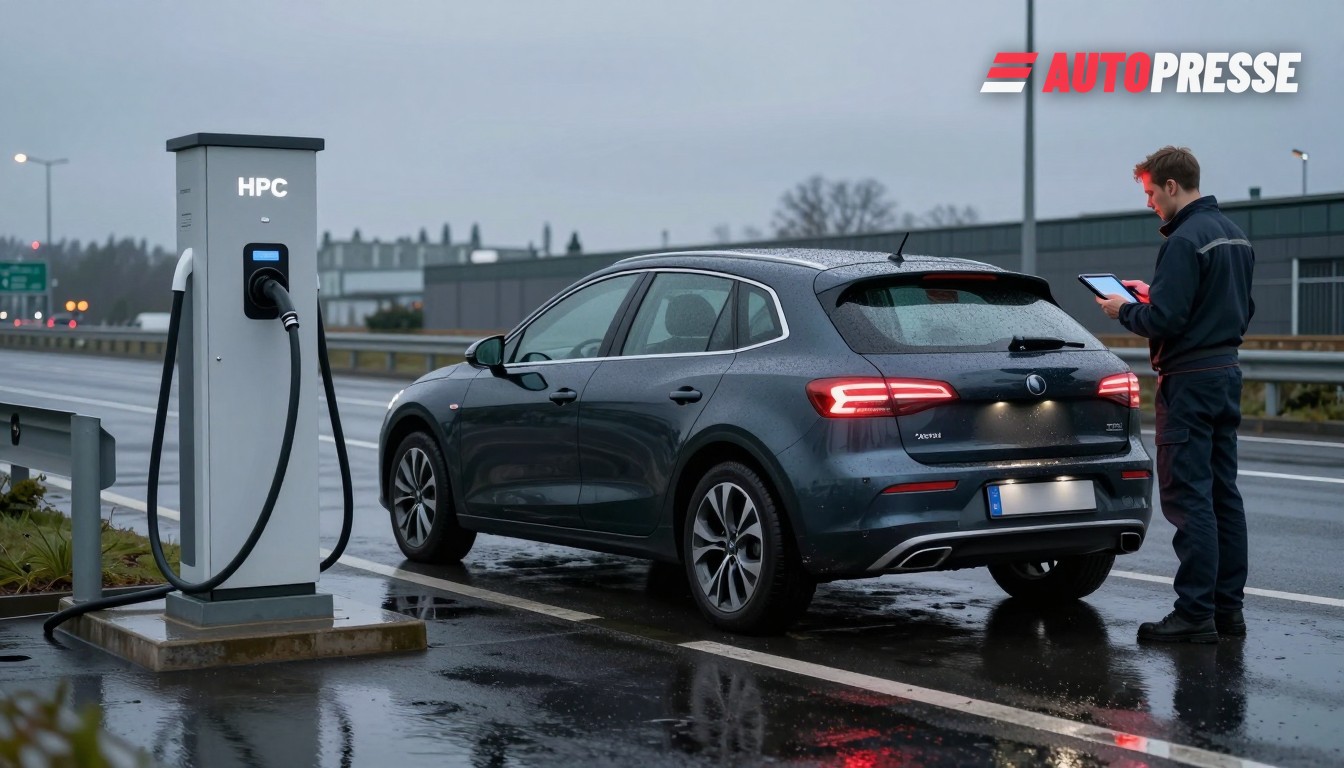
Germany and Austria are racing to scale public charging to meet rising electric vehicle demand — but recent research and industry data show the network’s size hides fresh technical vulnerabilities. Drivers, fleet operators and dealers now face not only coverage gaps but an urgent need for security and standardised testing to keep chargers reliable and safe.
Charging at scale — and at risk
Germany’s public charging register shows the country operates several hundred thousand publicly accessible charge points and multiple gigawatts of installed simultaneous power, underlining the sheer scale of the network that must be secured. Researchers developed a market‑analysis method in 2026 to extrapolate security test results across thousands of CCS points because examining each charger individually is infeasible — their Germany case study covered over 40,000 CCS locations to estimate national exposure. The paper argues that a small number of field tests can reveal systemic weaknesses and help planners prioritise interventions.
Independent trackers and industry groups report continued growth in public charging availability and in the share of high‑power stations — but growth is uneven across regions and operator types, which complicates standard approaches to cybersecurity and interoperability testing. The Verband der Automobilindustrie’s latest e‑charging ranking confirms regional differences in fast‑charging density and quality across Germany.
Industry and government responses
Governments and ministries in Austria and Germany are already pushing programmes to speed infrastructure deployment while emphasising reliability and user information. Austria’s eMOVE initiative frames fast‑charging expansion together with information efforts for drivers; the ministry highlights coordinated planning for motorway and local networks to avoid stranded investments. At the same time, industry stakeholders are discussing test regimes and certification steps that could move beyond simple plug‑and‑play checks to include software and network security audits.
Academics and security specialists recommend a layered approach: selective on‑site penetration testing, remote monitoring of charger firmware integrity, mandatory reporting of outages and standardised telemetry that regulators can audit. The marketplace already contains multiple operators with diverse hardware and back‑end software, so harmonised requirements — and an agreed method to scale testing results across fleets of chargers — would reduce duplicated effort and speed remediation.
What this means for the market
For drivers and fleet buyers, the takeaway is practical: reliability will increasingly depend on operator choice and the security posture behind the charger, not just on station density. Dealers and workshops should expect new certification and compliance tasks (firmware updates, cybersecurity checks and interoperability diagnostics) to appear in service schedules. For operators and municipalities, selective field testing paired with transparent reporting will be the fastest route to build user trust — and to avoid high‑profile outages that could slow EV adoption.
Electric vehicle listings on WorldTrader24 →
Sources: VDA, Bundesnetzagentur register (via Wattlas), arXiv cybersecurity study, BMIMI (eMOVE Austria), electrive.net