For drivers, landlords and electricians across Germany and Austria the question “who pays, who decides, who installs?” is no longer academic. Germany’s updated property and building rules give tenants and apartment‑owners a clearer legal route to a private charging point, while Austria’s approach remains fragmented: homeowners generally have rights but tenant protections and national grants vary by region and recently the federal support scheme was wound down.
What the law says in Germany — and what changes are coming
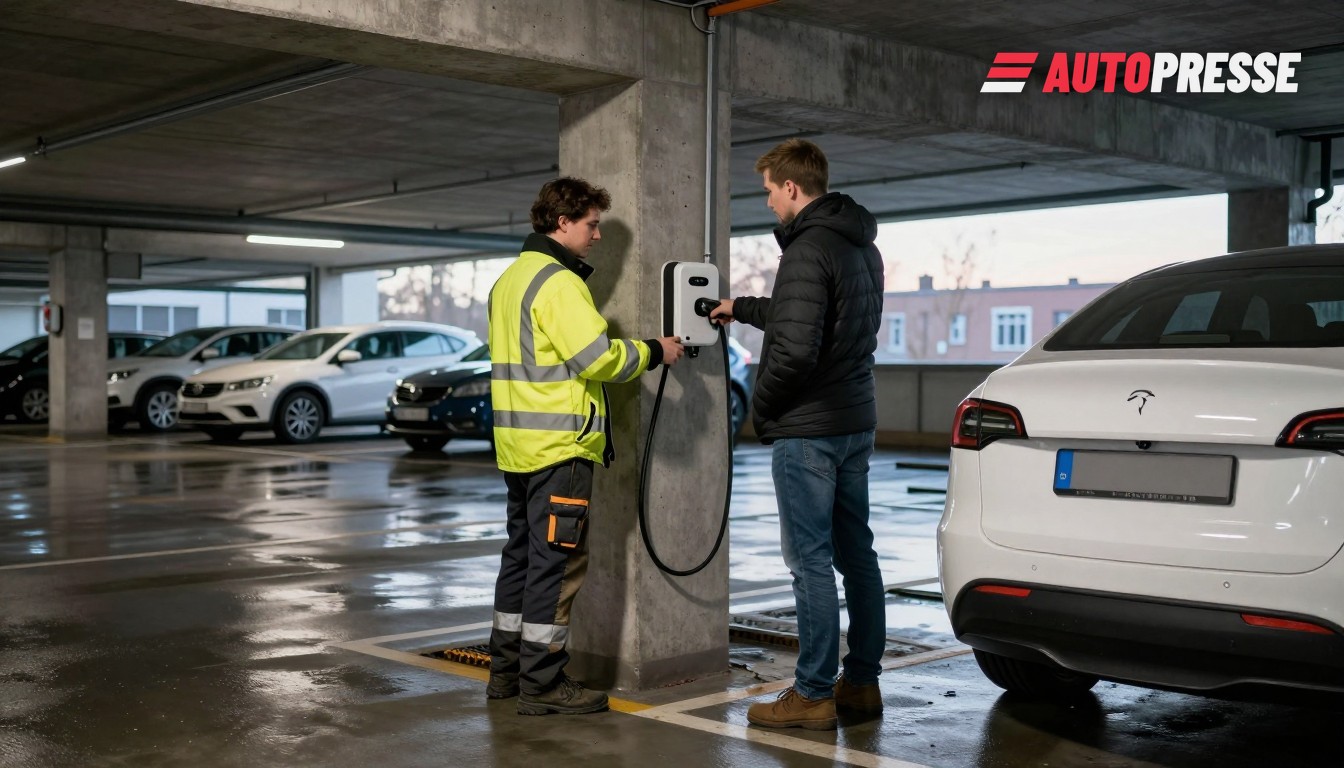
Since the WEMoG (the 2020 reform of the WEG/BGB framework) tenants and apartment owners can demand permission to install a charger at their allocated parking space; the owner community (WEG) or landlord can only refuse for narrow, legally grounded reasons and keeps a say over the technical implementation. Practical friction points — access to cable routes, meter space and the need for coordinated load‑management — remain common. German guidance and consumer groups stress planning the building’s cabling and an intelligent shared system from the start to avoid repeated retrofit costs.
Parallel rules in the Gebäude‑Elektromobilitätsinfrastruktur‑Gesetz (GEIG) force developers and larger renovations to provide pre‑wired infrastructure: until 31 December 2026 many obligations apply for buildings with more than five parking spaces, and from 1 January 2027 the threshold tightens (for example to buildings with more than three spaces and a 50% pre‑wiring requirement). That timetable makes 2026 the last practical year to get simple, lower‑cost prewiring settled under the older thresholds.
Austria: rights for owners, scattered support for tenants
In Austria the picture is more regional. The WEG‑style reforms give apartment owners the right to install a wallbox at their assigned stall and several local utilities and states (e.g., Salzburg) explicitly allow tenants to fit slow charging (typically up to 5.5 kW) at their own space — but there is no single nationwide entitlement for renters equivalent to Germany’s §554 BGB procedure. That creates legal uncertainty for tenants who lack a dedicated stall and leaves many negotiations to landlords and local authorities.
On top of the legal differences, Austria’s recent federal grant scheme for private and multi‑unit charging (“E‑Ladeinfrastruktur for Private 2025 / eRide”) has been closed; some provinces (for example Burgenland and Styria) continue smaller top‑ups, but the national level support that helped many pilot projects is no longer centrally available. That shift pushes the financing burden back to owners, housing cooperatives and local authorities.
What this means for the market
Builders and property managers: Germany’s clearer duties and the tightening GEIG deadlines turn prewiring into a near‑term compliance and commercial opportunity — developers who include scalable cabling and meter space now avoid costly retrofits and win market advantage.
Electricians and installers: demand will stay strong across both countries — but projects will shift from one‑off wallbox installs to integrated, multi‑point jobs with load management, metering and billing systems. Firms that can work with WEG processes, offer tenant/landlord contracts and supply smart metering will capture larger contracts.
Charge‑hardware and network operators: Germany’s legal clarity lowers a barrier to home charging and should increase private wallbox sales and the need for aggregated load control and roaming‑capable payment/management platforms. In Austria, uneven support means regional roll‑outs and pilot projects will continue to dominate; national scale requires either revived federal incentives or stronger municipal programmes.
For drivers and renters the takeaway is practical: if you have (or can secure) an assigned parking space, gather the technical details (metering, cable route, building decisions) and approach your landlord or WEG with a concrete, priced proposal. For tenants without fixed stalls expect more negotiation and, in some regions, a likely need to accept shared solutions rather than a private wallbox.
Electric vehicles and chargers on WorldTrader24 →
Sources: ADAC, Salzburg AG, Finanzinfo, Depow, ev.guru