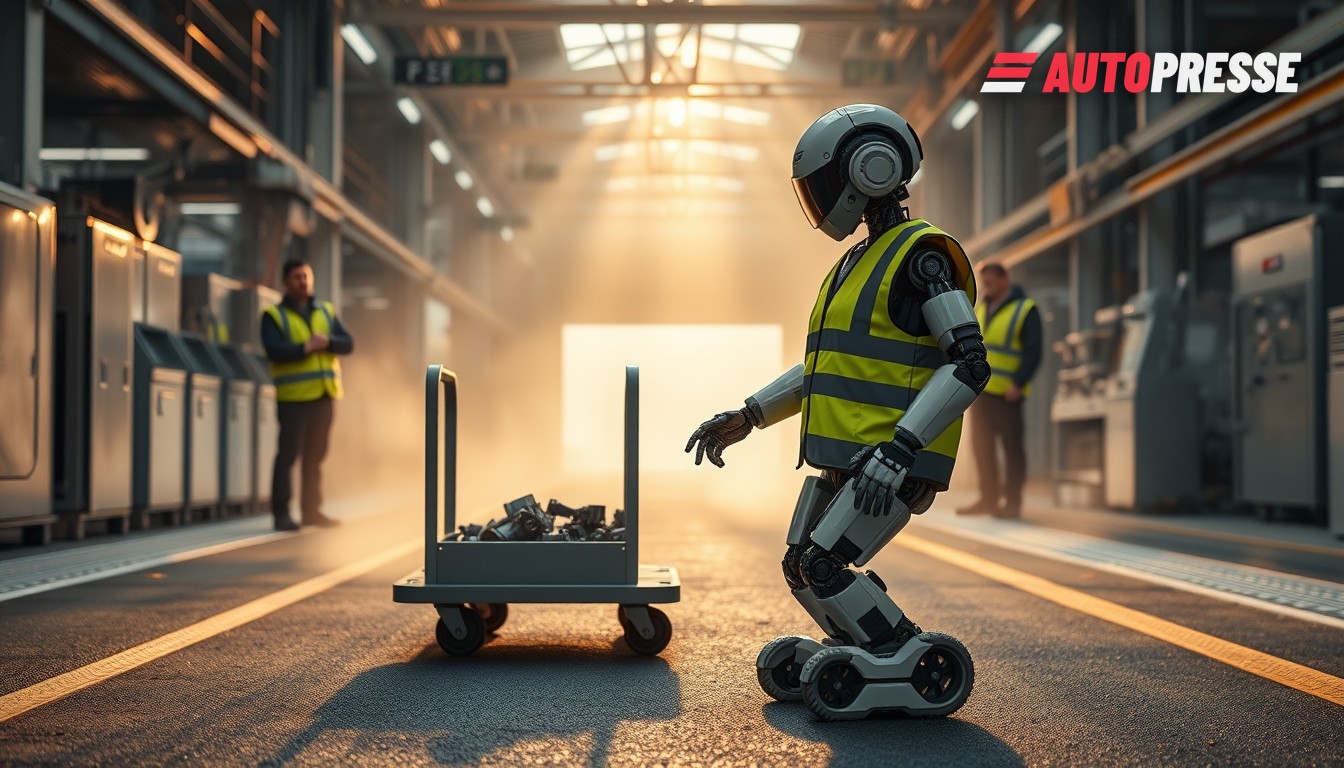
Audi has quietly begun testing mobile humanoid robots inside its Ingolstadt Production Lab in a proof‑of‑concept announced at NVIDIA GTC Berlin on 21 October 2026 — a development that matters for drivers, dealers and factory workers across Germany and Austria because it tackles one of the most labour‑intensive steps in car assembly: parts sequencing.
The trial pairs Munich‑based Agile Robots’ dual‑arm, mobile humanoids with Dassault Systèmes’ virtual‑twin tools and NVIDIA’s Isaac/Omniverse stack to pick components from mixed containers and place them in the exact order required at final‑assembly workplaces. Audi says its sequencing operations run at a scale of “around one million picks” every day, underlining the size of the task the partners want to automate.
How the pilot is built — and what we actually know
According to Audi’s media release the project is already under way in the Ingolstadt Production Lab; feasibility, timing, ergonomics and safety will first be checked in a virtual twin built on Dassault Systèmes’ DELMIA/3DEXPERIENCE environment and using NVIDIA Omniverse libraries. Audi highlights that the virtual companion LEO will help engineers shrink validation work “from months to days.”
NVIDIA’s GTC announcement described the vendor ecosystem behind the trial and named Agile Robots’ new reference humanoid — Agile ONE SN — as part of its Isaac platform, listing the research platform’s physical specs (1.40 m tall, 40 kg, 31 degrees of freedom, ~3 kg payload per arm) and the Jetson Thor compute stack that will run onboard reasoning. Those hardware and simulation pieces are central to moving dexterous picking from simulation into an actual logistics lane.
But the partners have not published operational figures: no timeline for a series rollout, robot counts or commercial terms were disclosed in the joint announcement or coverage of the event. Independent reporting and industry summaries note the announcement as a lab proof‑of‑concept rather than a production order.