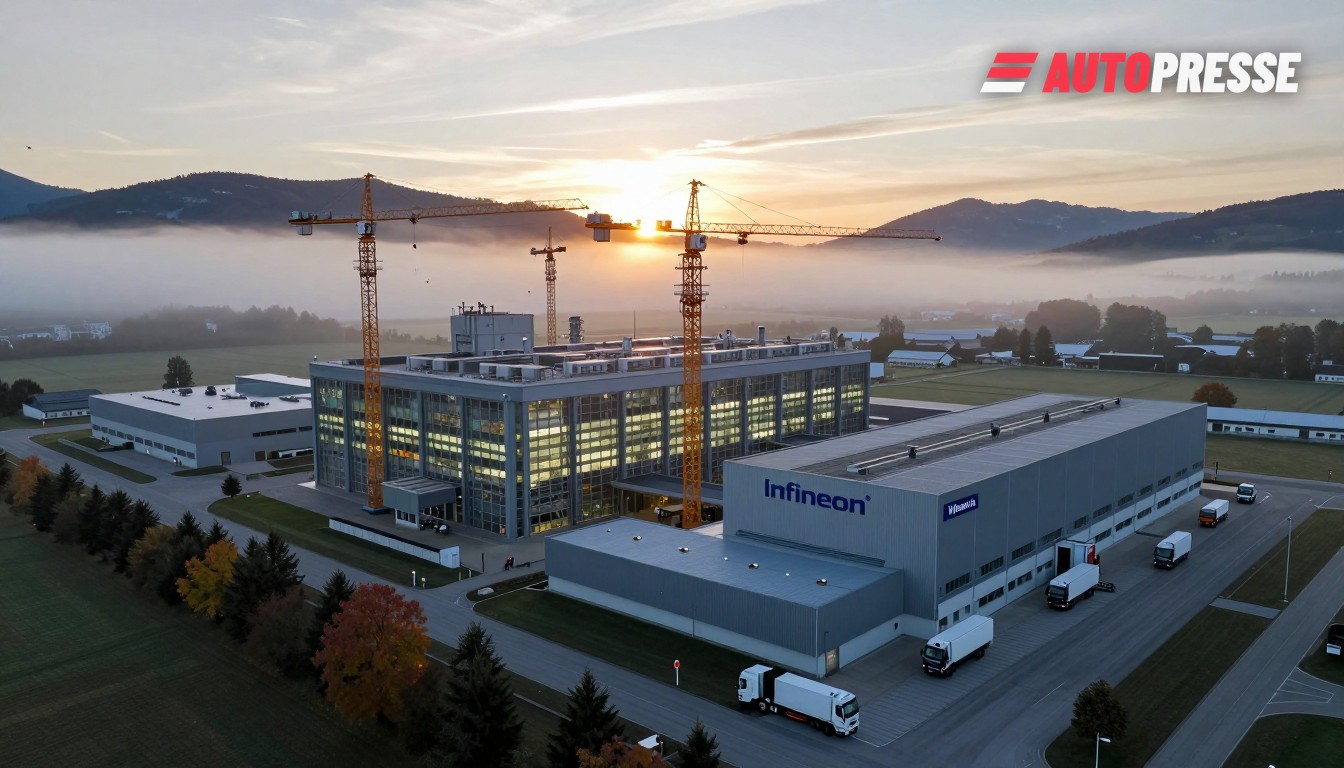
Two concrete moves this autumn have rewritten the technical backbone of electrification in Austria — and they matter to Germany, too. On 27 October 2026 Infineon announced a roughly €1.1 billion expansion at its Villach site to build high‑volume GaN power‑semiconductor production on 300‑millimetre wafers; the European Commission approved €319 million of Austrian state aid for the project the same day.
What was announced — and when
Infineon’s press statement (27 Oct 2026) set out a phased investment through 2034 and said the Villach upgrade will deliver next‑generation gallium nitride (GaN) power chips aimed at data centres, robotics and electrification applications; the company and market coverage put the high‑volume start at the end of 2027.
Parallel to the chip move, TU Austria selected “TU‑BRIDGE” as its first joint doctoral school on 30 March 2026 — a battery research and training centre hosted by TU Wien, TU Graz and Montanuniversität Leoben. The programme is recruiting 13 fully funded PhD posts (calls and application windows ran through 2026) to work on battery imaging, ageing, durability and recycling.
How Germany and Austria connect on this
Infineon’s Villach fab strengthens a pan‑German‑Austrian chip corridor: the company already runs large power‑chip fabs in Dresden and Villach, and the Villach GaN upgrade reduces Europe’s exposure to non‑European supply for power electronics used in EV inverters, on‑board chargers and fast‑charging stations — items that German OEMs and suppliers buy in large volumes. Infineon’s investor material and coverage make clear the Villach project is intended to scale capacity for power semiconductors across automotive and industrial markets.
At the same time TU‑BRIDGE will feed trained battery researchers and remanufacturing know‑how into Austria’s growing circular‑economy cluster. The doctoral school explicitly links imaging and ageing research to recycling processes — a practical skillset for workshops, recyclers and battery‑assembler suppliers in both countries.
What this means for the market
Short term: a measurable relief in the power‑electronics supply chain. A Villach ramp that reaches high‑volume GaN production (Infineon and market reports place a target at end‑2027) will lower lead times for key EV components and make high‑power charging and more efficient inverters easier and cheaper to source in Europe — a direct benefit for German OEMs and Austrian contract manufacturers.
Medium term: improved skills and circularity. TU‑BRIDGE’s 13 PhD positions and associated industry links accelerate battery‑cell knowledge, second‑life testing and recycling methods needed by workshops, fleet operators and recycling plants across DE & AT. That reduces risk for dealers and remanufacturers who today face high uncertainty when valuing used BEVs and buying replacement packs.
For drivers and fleets the combined effect is practical: faster rollout of reliable, Europe‑sourced power electronics should increase charger uptime and reduce costs for high‑power charging; better battery diagnostics and certified second‑life processes should stabilise used‑BEV residual values over the next 2–4 years. (Dates and figures above are drawn from Infineon’s and TU Austria’s announcements.)
WorldTrader24 B2B vehicle marketplace for dealers and suppliers →
Sources: Infineon Technologies, European Commission, TU Wien, TU Austria, Bloomberg