Germany and Austria are racing to plug heavy freight into high‑power electricity. Berlin secured EU state‑aid approval for a national programme worth up to €1.6 billion to deploy public e‑truck charging hubs along motorways, and private operators are already opening multi‑point sites at ports and truck yards — moves that reshape routes, depot investment and grid planning for drivers, fleet managers and dealers across both countries.
Hubs on the ground: ports and motorway nodes
Private charging operators have moved from pilots to permanent sites. Milence — the Daimler Truck / Traton / Volvo joint venture — opened a public e‑truck hub in Recklinghausen (Ruhr) and says it will triple its German charging capacity with hubs positioned on TEN‑T corridors.
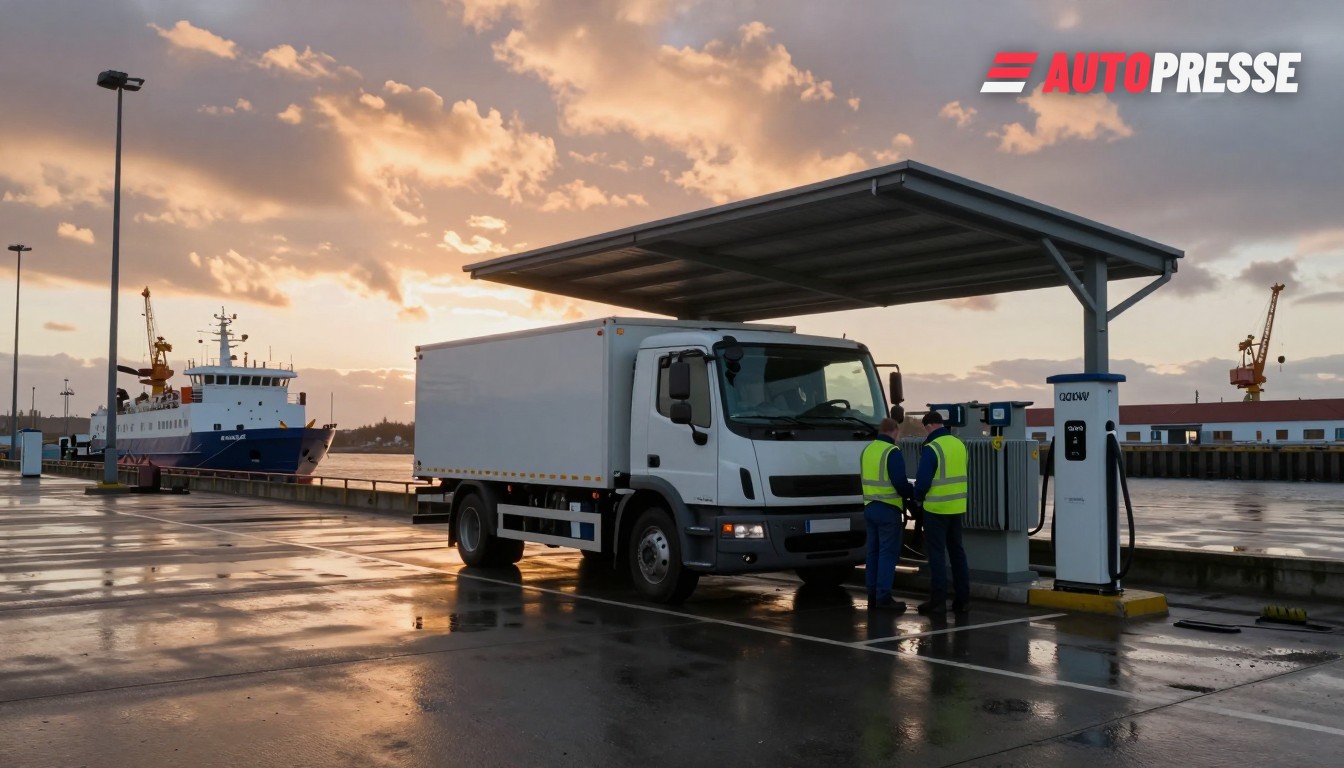
Ports are becoming charging nodes too: ENGIE Vianeo’s eight‑point HGV charging park at Kiel’s Ostuferhafen began operation on 1 September 2026 with 400 kW CCS bays and a 1,600 kVA transformer substation to stabilise peak loads — a template for combining ferry waits and fast charging on Scandinavian routes.
Austria’s rollout and reservation systems
Austria is following with coordinated public‑private sites. E.ON Drive Infrastructure and MAN broke ground for an e‑truck charging location in Eugendorf near Salzburg, part of five planned Austrian truck sites; E.ON reports about 16,000 electric commercial vehicles already registered in Austria and is developing a reservation system so drivers can book charging slots in advance.
Where the money goes
The €1.6bn German programme, approved by the European Commission on 18 December 2025, is intended to speed delivery of high‑power public hubs along national motorway corridors and unlock follow‑on private investment. Industry and energy groups stress three priorities: public corridor sites, depot charging support and faster grid connections via loans or AFIF / KfW instruments. The BDEW’s roadmap and industry pressure underline the need for both public MCS/Megawatt sites and simplified depot grid access.
Yet industry groups warn the planned national network still lags demand: the National Charging Infrastructure Control Center’s plan foresees about 4,200 public heavy‑vehicle charging points by 2030, but only a fraction are live today — and the VDA says Germany will need thousands more megawatt‑class chargers and much faster grid permitting to meet long‑haul needs.
What this means for the market
For fleets and logistics providers, the immediate consequence is a two‑track investment cycle: public corridor hubs will enable new long‑haul routes for battery trucks, while shippers and hauliers must fast‑track depot electrification to cover daily mileage and avoid queueing at public sites. Vehicle OEMs and dealers will see rising demand for fleet conversion services and depot consultancy. Grid operators and local authorities face planning pressure: transformer stations, reservation systems and workplace charging rules become as important as charger counts.
For Germany and Austria’s trade flows, the new hubs reduce range anxiety on key corridors (Rhine–Alpine, Scandinavian–Mediterranean) and make decarbonised freight commercially credible — but only if governments accelerate grid upgrades, speed permitting and align public funding with depot‑level support. The next 12–24 months will show whether planned public funds and private sites translate into a reliable, cross‑border charging backbone or leave fleets juggling patchy coverage.
WorldTrader24 B2B-Fahrzeugmarkt für Händler →
Sources: European Alternative Fuels Observatory, Milence, Faber E‑Tec / Port of Kiel / ENGIE, E.ON Drive Infrastructure, BDEW, VDA