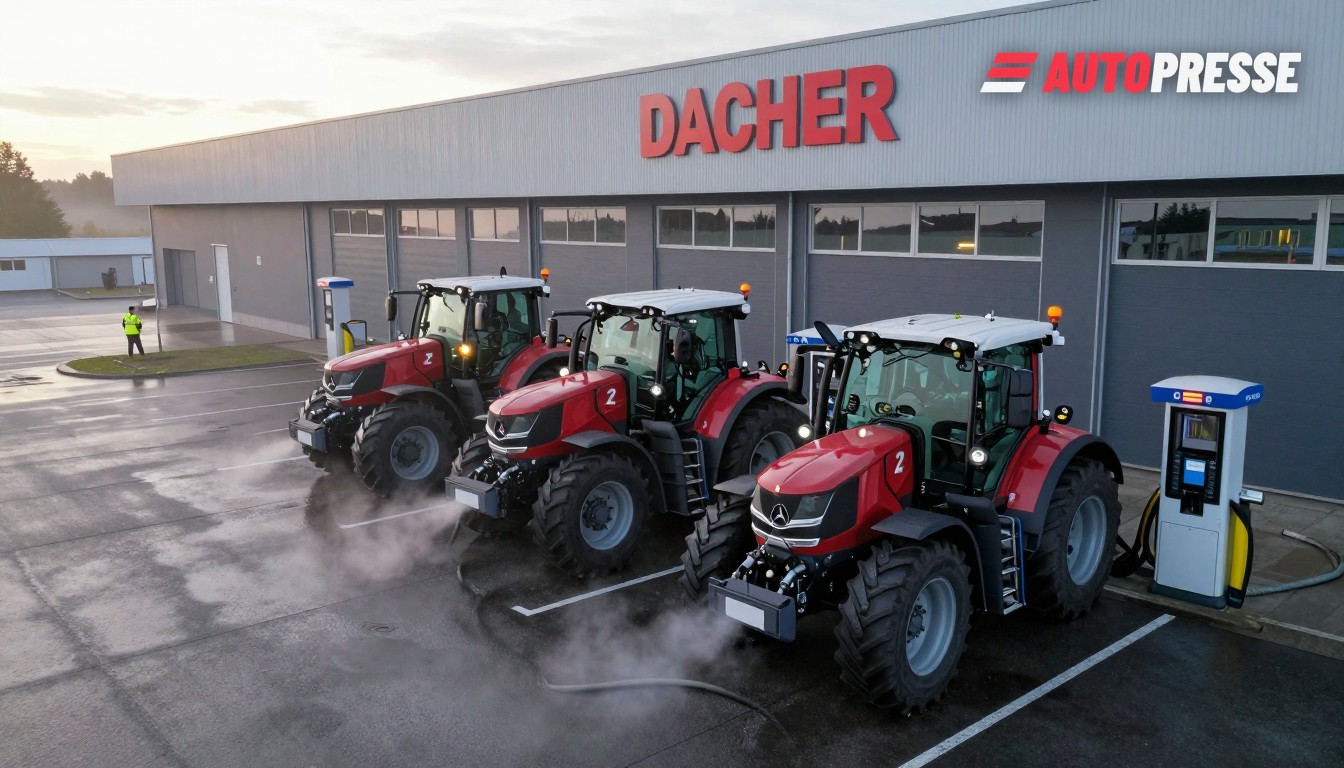
Daimler Truck is moving from lab to roads in Germany: the group will start delivering a small series of NextGenH2 hydrogen long-haul tractors and has also stepped up battery‑electric truck deployments with large fleet customers — developments that matter for German and Austrian buyers, dealer networks and component suppliers.
Latest developments (newest first)
Logistics provider DACHSER announced that three Mercedes‑Benz NextGenH2 trucks — the first units of a small series of 100 vehicles — will be put into operation at DACHSER’s Karlsruhe hub from the end of December 2026, with two further identical vehicles to follow by mid‑2027. Daimler Truck says the 100‑vehicle small series will be delivered to selected customers from end‑December 2026; series production is planned for the early 2030s.
On volumes, Daimler Truck reported a marked increase in unit sales: the group sold 91,260 vehicles in the third quarter of 2026, up 26% from 72,277 in Q3 2025, driven by Trucks North America and Mercedes‑Benz Trucks. At the same time battery‑electric truck and bus deliveries fell 28% in that quarter to 1,207 units. Daimler Truck published the Q3 unit figures on 8 October 2026 and will publish detailed Q3 financials on 6 November 2026.
On electrification partnerships, Mercedes‑Benz Trucks has begun handing over heavy eActros 600 battery‑electric tractors to major German fleets: Mercedes‑Benz Trucks delivered the first 27 eActros 600s to Amazon and says more than 50 eActros 600s will be in operation inside Amazon’s German transport network by the end of 2026. Separately, Daimler Truck showcased an eActros 600 deployment at Oktoberfest and the Cannstatter Wasen in early October as part of public demonstrations of long‑haul battery trucks in southern Germany.
These commercial signs follow a corporate update in July: on 22 July 2026 Daimler Truck raised its full‑year 2026 guidance, citing improved outlook in Trucks North America and the effect of updated US tariff treatment; the company lifted adjusted group EBIT guidance to a range of €3.6–4.1 billion and increased expected group unit sales to 340,000–370,000.
What this means for the market
Buyers (fleets and logistics operators): DACHSER’s Karlsruhe pilot confirms that Daimler Truck believes liquid hydrogen fuel‑cell tractors are near‑term deployable for long‑haul use where range and refuelling speed matter — DACHSER will test real route economics from end‑December 2026. At the same time, large BEV orders such as Amazon’s >50 eActros 600s in Germany show fleets are deploying mixed technology strategies depending on route profiles. Fleets should expect a growing choice between high‑range hydrogen prototypes and battery trucks for shorter interhub runs.
Dealers and service networks: the small series (100 vehicles) of NextGenH2 tractors and rising eActros volumes require new capabilities at dealer service locations — hydrogen handling, cryogenic or liquid‑hydrogen fuelling interfaces and high‑voltage BEV competence. Dealers in Germany and Austria should accelerate training and certify service bays for H2 safety and high‑voltage systems now that pilots are moving to customer sites.
Suppliers and tier‑1s: the simultaneous rise in conventional unit sales (Q3 volumes up to 91,260) and the low absolute BEV numbers (1,207 BEV trucks in Q3) underline mixed demand. Component suppliers need flexible production lines to serve internal‑combustion, battery and hydrogen powertrains. The July guidance raise also signals higher expected overall volumes for 2026, giving suppliers room to plan capacity — but they must hedge for segmented electrification demand.
Daimler Truck’s moves place Germany and Austria at the centre of both hydrogen pilot deployments and commercial BEV fleet rollouts. For buyers, dealers and suppliers the immediate task is operational: prepare infrastructure, reskill staff and test economics on real routes before scaled series production arrives in the early 2030s.
WorldTrader24 B2B vehicle marketplace for dealers and fleet buyers →
Sources: Daimler Truck, DACHSER, EuropaWire, Transport‑Online, AD‑HOC News