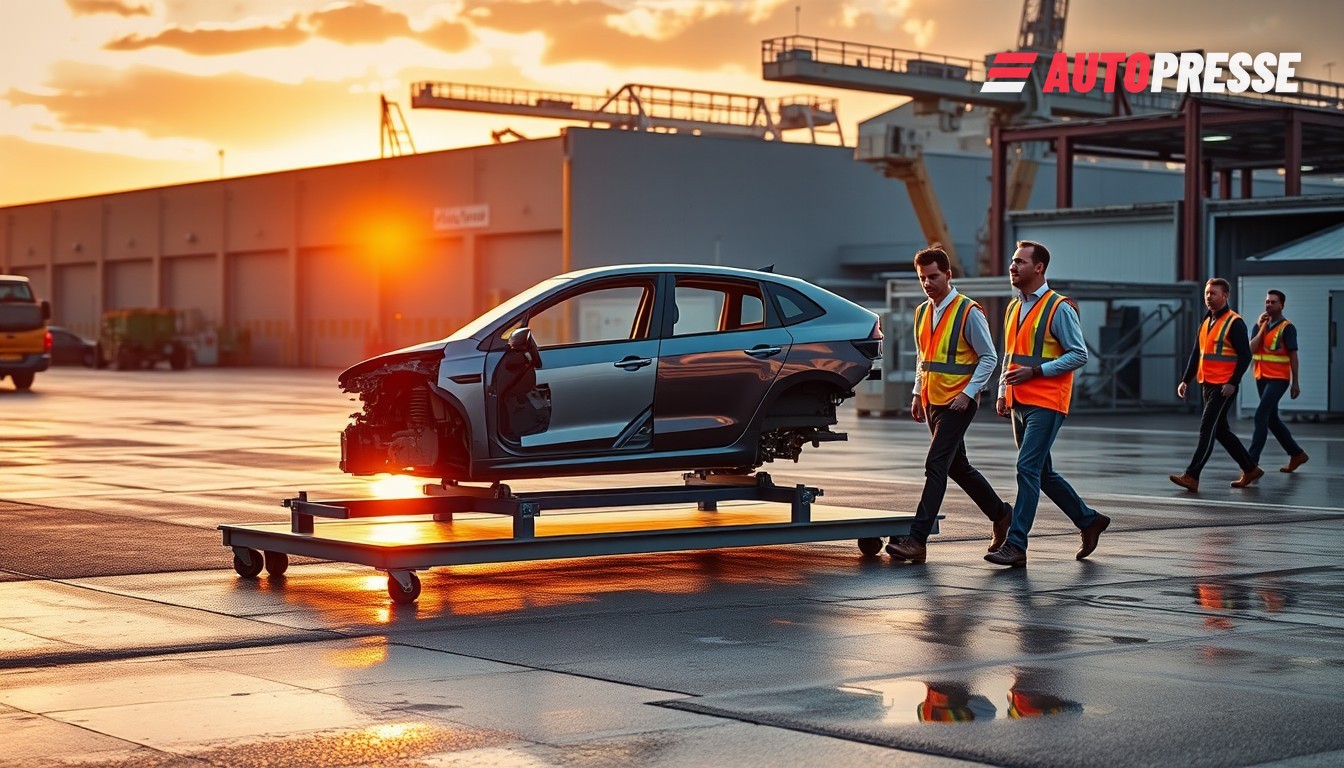
Volkswagen has given a high‑profile German plant a new role: on 28 October 2026 the company and Saxony opened an industrial dismantling line at the Zwickau vehicle factory, creating what VW calls its first Circular Economy Hub. For drivers, dealers and workshops the move promises cheaper original parts; for employees it is a bet on new kinds of factory work — but it arrives against continuing uncertainty over vehicle production at the site after 2031.
What opened in Zwickau
The new line will begin full operations in 2027 and is planned to dismantle 4,100 pre‑series and end‑of‑life vehicles per year in a two‑shift rhythm, using an initial workforce of 100 retrained employees. Volkswagen says the CE‑Hub will recover original parts, batteries and recyclable materials for reuse and resale. Saxony’s state government and VW presented the first eight takt stations of the line at the 28 October launch.
Volkswagen has positioned Zwickau as the Group’s competence centre for circular economy activity. The company plans up to €90 million of investment at the site and the Free State of Saxony is providing support of up to €10.7 million for the project. VW’s internal documents also show a staged plan to expand dismantling capacity toward 15,000 vehicles per year by 2030 if the concept scales.
How the hub works (brief)
The operation separates three value streams from each returning vehicle: (1) tested original parts for resale via dealer and service networks, (2) batteries for assessment, repair or second‑life uses before material recovery, and (3) metals and plastics recovered for reuse in production. Volkswagen says data platforms and AI will track material flows and quality to make recovered components usable at scale.