Brussels’ Clean Vehicles Directive (CVD) fixes minimum national procurement targets for public fleets — and Germany and Austria have taken very different routes to meet them. For light vehicles the EU sets a 38.5% minimum share of “clean vehicles” for the 2026–2030 period; for heavy vehicles it requires 15% of new trucks and 65% of buses (with at least half of bus targets to be fulfilled by zero‑emission buses). These are binding at Member‑State level but allow national flexibility in how contracts and regions share the effort.
Germany: legally tighter, politically messy
Germany transposed the CVD into national law with the Saubere‑Fahrzeuge‑Beschaffungs‑Gesetz (SaubFahrzeugBeschG). The law codifies the EU reference periods (2 Aug 2021–31 Dec 2025 and 1 Jan 2026–31 Dec 2030) and applies quotas across federal, Länder and sector contracting authorities. The federal administration’s own minimum for clean cars in the second reference period (2026–2030) is set higher at 42.5%. The law’s first amendment entered into force on 28 May 2024 and also restricts the use of fossil‑derived synthetic paraffinic fuels in new contracts from 29 May 2024.
But official target rules and real‑world procurement are not the same thing. The Deutsche Umwelthilfe’s 20th "Dienstwagen‑Check" — an audit of ministers’ official cars carried out January–June 2026 and published 1 September 2026 — found that only 90 of 249 ministerial cars (36%) were battery‑electric, while plug‑in hybrids accounted for 42% and pure petrol/diesel cars remained widespread. The DUH warned this is a backward step for the government’s climate signalling and stressed that many newly procured ministerial vehicles were plug‑in hybrids rather than efficient BEVs.
Austria: naBe pushes pure‑EV procurement locally
Austria uses the national Action Plan for Sustainable Public Procurement (naBe) to push public buyers further and earlier. naBe’s vehicle criteria state explicitly that “from 2022, all new vehicles [should be] pure electric vehicles,” with narrowly defined exceptions for operational range, charging access or required vehicle size. naBe is advisory and implemented through federal and municipal procurement rules, but it already underpins visible municipal projects.
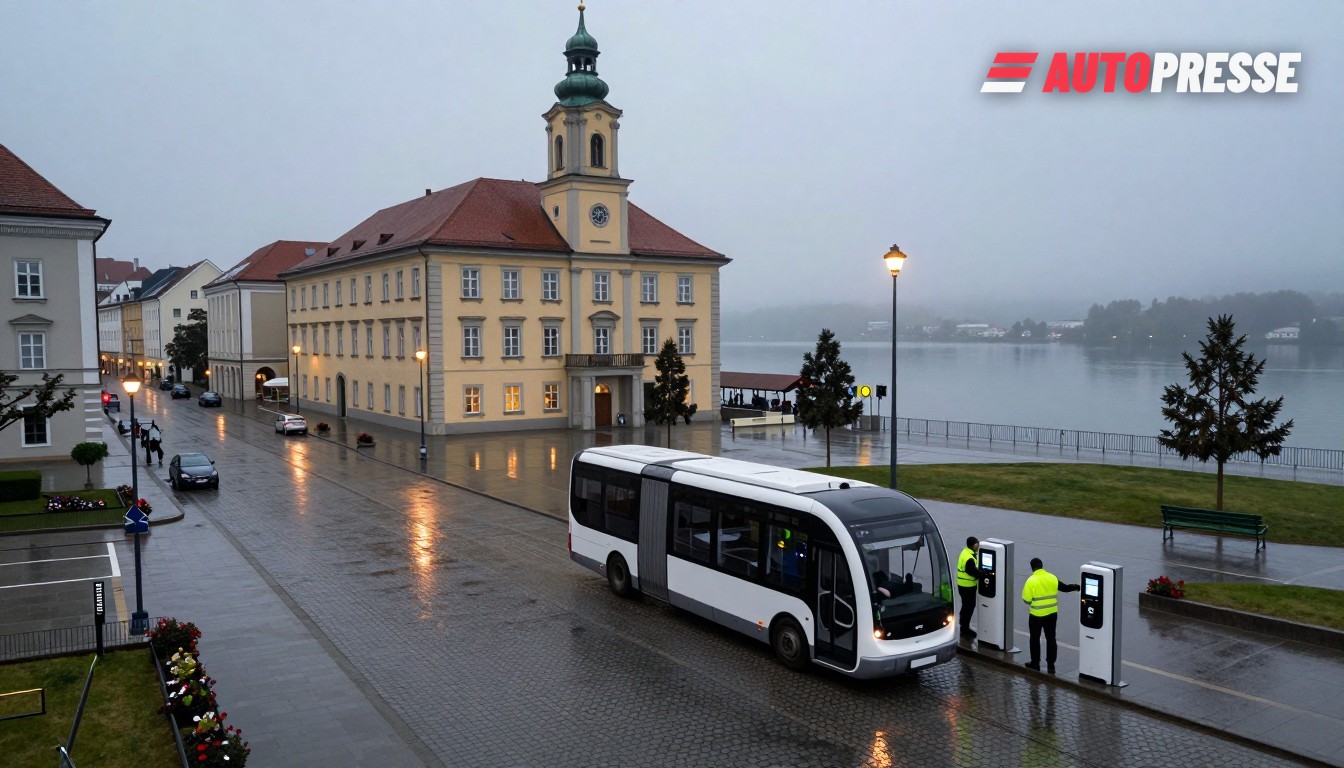
Local examples show how naBe can work in practice: the city of Klagenfurt’s CEMOBIL and E‑Log projects procuring 69 electric vehicles (35 passenger cars, 2 commercial vehicles, 10 microcars, 10 pedelecs, 10 scooters, 1 e‑bus and 1 solar‑powered boat), plus installation of 50 public chargers and two fast chargers, illustrate an implemented procurement strategy that pairs vehicles and infrastructure. Klagenfurt reports the e‑fleet remains in daily service and is supplied with 100% green electricity.
What this means for the market
Short term, vehicle makers and fleet managers face diverging demand signals inside the German‑speaking market: Germany’s law raises mandatory quotas (and the federal 42.5% floor for 2026–2030), but procurement practice — especially at ministerial and some Länder levels — has not yet matched the legal ambition, according to civil‑society monitoring. Austria’s naBe creates clear local demand for pure BEVs and charging, especially for municipalities that adopt the criteria wholesale. The net effect: stronger, earlier municipal and regional demand for BEVs and charging hardware in Austria; a legally robust but unevenly applied demand pull in Germany that will favour suppliers able to work with federal procurement processes and to retrofit charging to complex institutional sites.
Electric vehicle listings on WorldTrader24 →
Sources: European Commission, Bundesministerium für Verkehr, Deutsche Umwelthilfe, naBe (Austrian naBe platform), Austrian Federal Ministry (BMLUK)