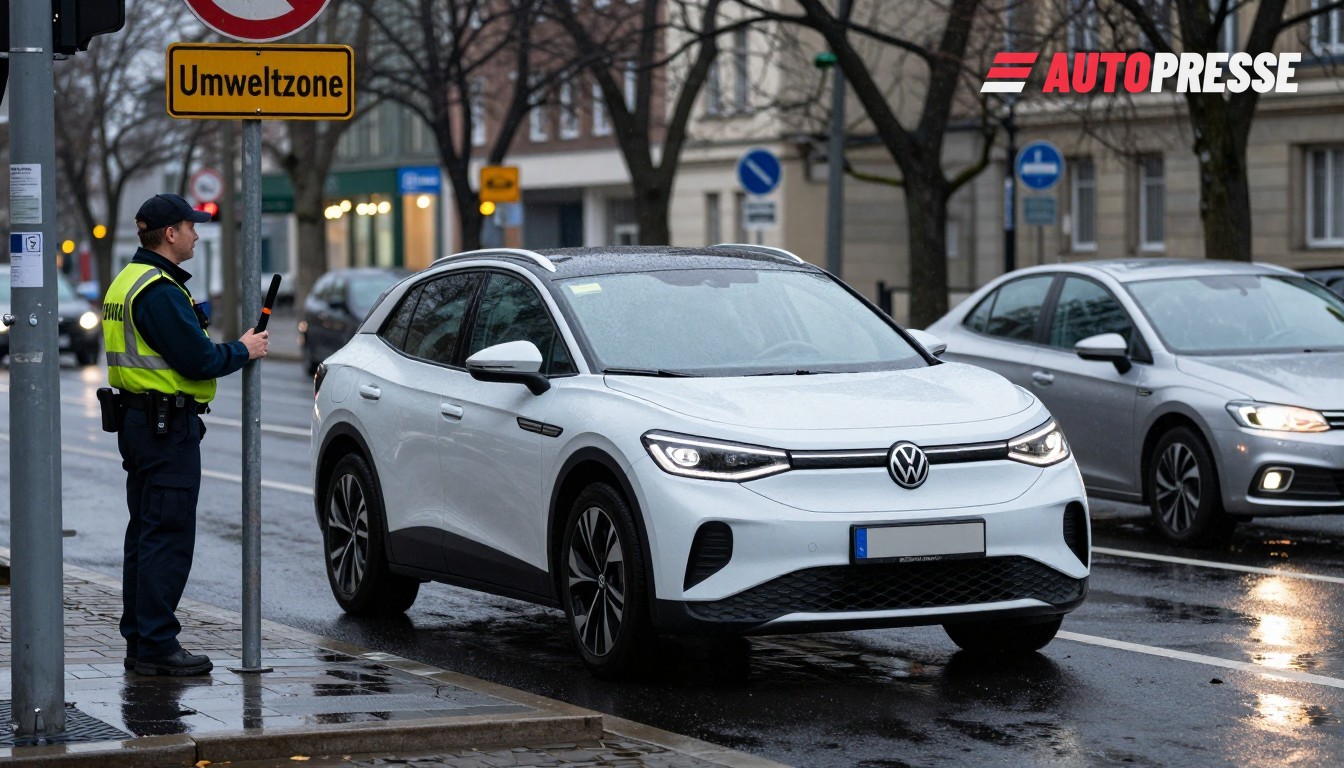
Policy moves in Vienna and Berlin are reshaping the practical incentives for electric vehicles across Germany and Austria — and they matter to drivers, fleet managers, dealers and payroll teams. Austria has announced a new taxable benefit for staff who use employer EVs privately, while Germany has removed a long‑standing paperwork quirk by recognising the E (electric) licence plate as sufficient proof to enter Umweltzonen without an extra green sticker.
Austria: a phased taxable benefit for electric company cars
The Austrian budget package for 2027–2028 ends the full exemption that made employer EVs tax‑free as a salary benefit. From 1 January 2027 a monthly Sachbezug of 0.375% of the vehicle’s acquisition cost (incl. VAT and NoVA) will apply for battery‑electric cars used privately, capped at €180 per month; from 1 January 2028 the rate rises to 0.625% with a €300 monthly cap. The tax base is itself capped at €48,000 (gross) for the purpose of this calculation. These measures were set out in the Budgetbegleitgesetz and the related change to the Sachbezugswerteverordnung.
Practical effects for employers and employees are immediate: salary‑sacrifice schemes and fleet procurement plans must be rechecked before 2027, because the new rule also creates VAT considerations for vehicles that entitle the employer to input tax. Industry advisors and accountants have published worked examples showing the largest impact on lower‑priced BEVs, where the percentage‑based levy hits proportionally harder.
Germany: E‑plate replaces green Umwelt‑plakette
In Germany the federal government has removed the requirement to display the green environmental sticker for vehicles carrying an E licence plate: since the BImSchV amendment was published in the Bundesgesetzblatt in late September 2026, the E plate itself is sufficient proof to enter designated Umweltzonen. The change was presented as part of a broader package to reduce bureaucratic burdens in July 2026. Municipalities and enforcement authorities now recognise the E‑plate in traffic controls, while drivers who chose not to register for an E‑plate must still display the green sticker.
At the same time, Germany’s preferential company‑car rules for zero‑emission vehicles remain generous: the reduced taxable‑benefit calculation (commonly called the “0.25% rule”) applies to pure EVs whose list price at first registration does not exceed €100,000 (higher than earlier thresholds introduced in 2025). That keeps employer EVs attractive in Germany even as Austria tightens its position.
What this means for the market
Austrian fleets and salaried drivers will feel the change in their pay slips: the new Sachbezug turns a formerly tax‑free perk into a modest monthly cost (examples and caps are in the budget law and implementing regulations). Fleet managers in Austria will likely prioritise lower‑priced BEVs (to keep the capped base in play), revisit lease contracts and revisit salary‑packaging offers. Tax advisers warn employers to revisit Gehaltsumwandlungs and VAT handling before 2027.
In Germany the removal of the double‑marking (E‑plate plus green sticker) cuts small but widespread friction: drivers save time and the state saves administrative costs, while municipal enforcement simply checks the licence plate. For dealers and registration offices it removes one routine step when delivering battery EVs. Combined with the continued 0.25% company‑car advantage for many EVs, Germany remains a friendlier fiscal environment for employer fleets than Austria from January 2027.
Electric cars listings on WorldTrader24 →
Sources: electrive.net, BG&P (Budgetbegleitgesetz guide), Bundesministerium für Umwelt (BMU), Bundesregierung, Haufe, Finanztip, Parlament.gv.at